How to Start a White Label Casino in 7 Steps (2026 Operator Guide)
What exactly is a white label casino and how does it differ from a turnkey build?
A white label casino is a pre-built, licensed gambling platform you rebrand and operate under your own name. The provider owns the master license and technical infrastructure; you own the brand, the player relationship and the marketing budget. A turnkey solution is similar but typically hands you a standalone license and codebase you fully control — at a higher cost and longer timeline.
The practical difference matters more than the terminology. With a true white label, you are operating as a sub-licensee under the provider's master license — common with Curaçao-based operators using platforms like SoftSwiss's white label arm or Turnkey Casino. That arrangement gets you to market in 4–8 weeks, but it also means the platform provider is your silent regulatory landlord. They can pull the plug if you breach their compliance rules, and their master license terms constrain what markets you can target.
A turnkey solution — offered by EveryMatrix, SoftSwiss's standalone build, or Digitain, among others — means the platform vendor builds and configures the casino for you, but you apply for your own license and own the codebase (or at least have a long-term license to it). Setup takes 3–6 months and costs more upfront, but you have genuine operational independence. The revenue-share model common in white labels (typically 15–50% of GGR going to the platform) is replaced by a flat SaaS fee or one-time build cost.
For first-time operators with limited capital who want to test a market before committing, white label is the right starting point. For operators who already have a player database, a strong brand, or a specific regulated market in mind (say, a US state or Colombia under Coljuegos), turnkey or custom is almost always the better long-term economics. The mistake I see constantly is operators starting white label in a market that requires their own license anyway — at which point the speed advantage of white label evaporates and you're paying revenue share indefinitely for no good reason.
| Factor | White Label | Turnkey | Custom Build |
|---|---|---|---|
| Time to launch | 4–8 weeks | 3–6 months | 12–24 months |
| Upfront cost (est.) | $5k–$30k setup | $30k–$150k | $200k–$1M+ |
| Ongoing cost model | Revenue share (15–50% GGR) | SaaS fee + smaller rev-share | Internal ops + licensing |
| License ownership | Provider's master license | Your own license | Your own license |
| Customisation depth | Limited (skin/brand) | Moderate | Full |
| Market restrictions | Provider-set limits | Jurisdiction-dependent | Full control |
| Best for | First-time operators, market testing | Scaling operators | Established groups |
Which licensing jurisdiction should you choose for a white label casino launch?
For most operators launching a white label in 2026, Curaçao (under the new CGOA framework) or Anjouan are the fastest offshore routes. MGA and UKGC are the credibility benchmarks but require 6–18 months and significantly higher capital. Your target player geography should drive this decision — not what's cheapest on paper.
Curaçao overhauled its licensing regime in 2023–2024 under the new Curaçao Gaming Authority (CGOA). The old master-license sub-license model is being phased out; by 2025–2026 operators need their own Curaçao license. Application fees run roughly $17,000–$25,000 with annual renewal in a similar range. Processing time is 2–4 months if your documentation is clean. For a white label operator, this means your platform provider may still hold the technical certification, but you need your own operator license — check this explicitly with any vendor pitching you a Curaçao white label.
Anjouan (Comoros) emerged as a genuine alternative around 2022–2023. Licensing fees are lower — roughly $15,000–$20,000 all-in — and processing can be faster, sometimes 4–8 weeks. The trade-off is lower brand credibility with sophisticated players and some payment processors who won't work with Anjouan-licensed operators. It's a solid choice for crypto-focused casinos or operators targeting markets where the license badge matters less than the product.
If you're targeting regulated EU markets, the Malta Gaming Authority (MGA) is the gold standard. Expect a 6–12 month application window, a €25,000 non-refundable application fee, and capital requirements of €100,000 or more depending on license type. UKGC is even more demanding — £25,000+ application fee, extensive AML/KYC compliance infrastructure, and a 12–18 month timeline. Both are worth it if your business model depends on UK or EU payment processing and mainstream advertising, but they're incompatible with the speed proposition of white label.
For LATAM operators, Colombia (Coljuegos) and Peru (MINCETUR) have active regulated frameworks, but these require local entity establishment and are not compatible with offshore white label sub-licensing. Mexico's SEGOB framework is notoriously slow and opaque. Most LATAM-focused white label launches use Curaçao or Anjouan as the licensing base and operate in a grey-market posture in specific countries — which carries real enforcement risk that vendors consistently downplay.
| Jurisdiction | Regulator | Est. Cost (all-in) | Timeline | Best For |
|---|---|---|---|---|
| Curaçao | CGOA | $17k–$30k | 2–4 months | Offshore, global targeting |
| Anjouan | ADGM/Anjouan Authority | $15k–$22k | 4–8 weeks | Crypto casinos, fast launch |
| Malta (MGA) | MGA | €50k–€150k+ | 6–12 months | EU-facing, tier-1 operators |
| UK (UKGC) | UKGC | £50k–£200k+ | 12–18 months | UK market exclusively |
| Gibraltar | Gibraltar RGA | £35k–£100k+ | 6–9 months | EU/UK adjacent operators |
| Colombia | Coljuegos | Varies (local entity) | 6–12 months | Colombian market only |
How do you choose the right white label casino platform provider?
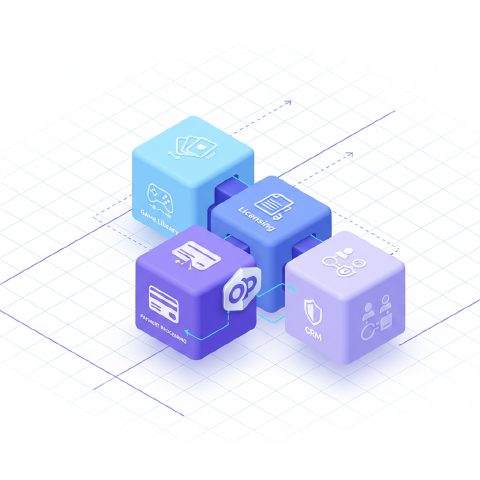
Evaluate providers on five things: what's actually included in the revenue share, which game aggregators are pre-integrated, payment method coverage in your target market, the quality of the back-office and reporting tools, and whether the provider's master license covers your target geographies. The sales deck will look identical across vendors — the contract is where the differences live.
SoftSwiss is one of the most established names in white label and turnkey casino infrastructure. Their white label product bundles a game aggregator (SOFTSWISS Game Aggregator with 10,000+ titles), sportsbook option, and back-office. Revenue share typically starts around 15–20% of GGR for the platform, on top of which you pay game provider royalties. The advantage is a genuinely mature product with solid reporting; the disadvantage is that you're one of hundreds of SoftSwiss-powered brands, which makes differentiation harder.
EveryMatrix operates differently — their CasinoEngine and OGS (Operator Game Server) are more modular. You can license components separately, which suits operators who already have some infrastructure and want to add a game aggregator or sportsbook module rather than replacing everything. Their Curaçao-licensed white label product is aimed at operators who want faster go-to-market without full platform replacement. Pricing is typically SaaS-based with a smaller revenue share component.
Smaller providers like Turnkey Casino, BetConstruct, and Digitain compete aggressively on price and speed. I've seen Turnkey Casino get operators live in under 30 days, which is impressive — but the back-office tooling is thinner and the payment integrations require more operator-side work. BetConstruct has strong sportsbook DNA and is a good fit if sports betting is your primary vertical. Digitain has made serious inroads in LATAM and Eastern Europe. None of these are bad choices, but none are identical to SoftSwiss either.
One thing vendors rarely volunteer: check whether the platform's game aggregator has direct certification in your target jurisdiction. A game that's certified under MGA may not be certified under Curaçao CGOA's new rules, and vice versa. If you're launching in a regulated market, your platform provider's game library coverage in that specific jurisdiction is a harder constraint than the total number of titles they advertise.
What does it actually cost to start a white label casino in 2026?
Realistic all-in launch costs run $30,000–$120,000 for the first year, excluding marketing. That covers licensing ($15,000–$50,000 depending on jurisdiction), platform setup fees ($5,000–$30,000), payment processing setup, KYC/AML tooling, and a minimal content budget. Vendors quoting $10,000 all-in are excluding the fees that will surprise you at month two.
Here's how the budget actually breaks down. Licensing is the biggest fixed cost and the one most often quoted net of the hidden pieces: Curaçao's CGOA license runs $17,000–$25,000 in application and first-year fees, but you'll also pay a local representative fee ($3,000–$8,000/year), a registered office fee, and often a compliance consultant to prepare the application ($2,000–$5,000). Anjouan is cheaper but still clears $15,000–$20,000 total when you add agent fees.
Platform setup fees vary enormously. Some white label providers charge a flat setup fee of $5,000–$15,000 and then take revenue share. Others charge nothing upfront but take 30–40% of GGR, which is punishing at scale. Run the math at your projected GGR: if you're targeting $100,000/month GGR within year one, a 35% revenue share is $35,000/month going to the platform — far more expensive than a SaaS model. The cheap-setup, high-revenue-share structure is designed for operators who don't grow; if your business plan works, it becomes your biggest cost line.
Payment processing setup is frequently underestimated. You'll need a merchant account or crypto payment gateway, and many acquiring banks charge setup fees of $1,000–$5,000 plus monthly minimums. KYC/AML tooling — providers like Sumsub, Onfido, or Veriff — runs $0.50–$2.00 per verification plus monthly platform fees. If you're expecting 500 new registrations per month, budget $500–$1,500/month just for identity verification. Responsible gambling tools (reality checks, self-exclusion, deposit limits) are often bundled into platform fees but sometimes aren't — ask explicitly.
Then there's the marketing budget, which I'd argue is the most important line item and the one most first-time operators undersize. A white label casino with no player acquisition budget is just a website. Realistic CAC (customer acquisition cost) in competitive markets runs $150–$600 per depositing player depending on channel. Budget at least $20,000–$50,000 for the first 90 days of marketing if you want meaningful data on whether your product works.
How do you set up payments for a white label online casino?
Payment setup is the single most common reason white label casinos fail to convert after launch. You need at minimum one card processor, one local payment method for your primary market, and a crypto option. Getting all three live before launch — not after — is non-negotiable. High-risk merchant accounts take 2–6 weeks to approve; don't start this process last.
The iGaming payment stack has three layers. The first is acquiring — a bank or payment institution willing to process card transactions for a gambling merchant. This is genuinely high-risk territory; most mainstream acquirers refuse gambling merchants outright. Specialist iGaming acquirers like Payvision (now ING), Safecharge (now Nuvei), Paysafe, or Worldpay's gaming division are the usual routes. Expect rolling reserves of 5–10% held for 90–180 days, higher MDRs (merchant discount rates) of 3–7% versus 1.5–2% for normal e-commerce, and a thorough underwriting process that requires your license, business plan, and chargeback mitigation policy.
The second layer is local payment methods — and this is where operators lose players silently. A Brazilian player who can't pay via PIX, a German player without SOFORT, or a Canadian player without Interac is a player you've already lost. Your white label platform provider's payment integrations are a starting point, but they're rarely complete for every market. Providers like Nuvei, Trustly, and Zimpler cover broad European local payment method networks. For LATAM, EBANX and Pagsmile are the specialists. For crypto, NowPayments, CoinsPaid, or BitPay integrate cleanly with most casino platforms.
The third layer is e-wallets — Skrill and Neteller (both Paysafe) are the historical iGaming standbys, though their market share has eroded in markets where faster bank transfers have taken over. PayPal is effectively unavailable for offshore gambling operators; don't waste time pursuing it. Apple Pay and Google Pay are available through some iGaming-friendly acquirers for card-on-file transactions, but acceptance varies by region and card network rules.
One operational point vendors skip: your KYC process must be synchronized with your payment flow. A player who deposits $200 via crypto and then hits a KYC wall when they try to withdraw will chargeback and leave a review. Build the identity verification trigger into the deposit flow at a sensible threshold — typically $150–$500 first deposit or $2,000 cumulative — before launch, not as a patch afterward.
What games and software providers should a white label casino launch with?
Launch with 500–1,500 games across slots, live dealer and table games minimum. Pragmatic Play, Evolution Gaming and Hacksaw Gaming are non-negotiable for credibility. Your white label platform's aggregator handles most of this automatically — but verify which studios are actually certified in your license jurisdiction before assuming they're available.
Most white label platforms bundle access to a game aggregator that handles revenue reporting, certification management, and API connectivity with dozens of studios. SoftSwiss's aggregator connects to 200+ studios. EveryMatrix's OGS connects to 150+. The headline numbers look impressive, but the practical question is which studios are live and certified under your specific license. A studio that's MGA-certified may not yet be CGOA-certified, and operating uncertified games under a Curaçao license is a compliance violation.
For slots, the must-have studios in 2026 are Pragmatic Play (by volume, the dominant supplier), Hacksaw Gaming (high-volatility content that converts well with bonus hunters), Play'n GO, NetEnt (now part of Evolution), and Relax Gaming. These five studios alone cover the bulk of what a typical player expects to find. NoLimit City and Push Gaming have strong cult followings worth including. For table games, RNG versions from these same studios are usually sufficient at launch.
Live dealer is increasingly a baseline expectation, not a premium feature. Evolution Gaming is the dominant live dealer supplier globally — their live blackjack, roulette, and game show content (Crazy Time, Monopoly Live) drives significant GGR at established casinos. Pragmatic Play Live is a credible alternative with competitive pricing and solid studio quality. Ezugi (also Evolution-owned) is worth adding for LATAM-focused operators given its Spanish-language dealer options. Budget for live dealer revenue share of 10–15% of live GGR on top of your platform fee.
Sports betting is worth a brief mention: if you're launching a casino-first white label, don't add a sportsbook in week one. Sportsbook operations require separate compliance infrastructure, trading risk management, and odds feed integrations. Operators who launch both simultaneously almost always execute both poorly. Get the casino product right, then add sports at month six or twelve using a turnkey sportsbook provider like Kambi, SBTech (now DraftKings' tech arm), or BetConstruct.
How do you handle KYC, AML and responsible gambling compliance for a white label casino?
Compliance is not something you configure once and forget. Your white label provider handles the technical infrastructure, but you — as the license holder or sub-licensee — are operationally responsible for KYC, AML screening and responsible gambling controls. Regulators fine operators, not platform providers, when players slip through.
KYC (Know Your Customer) for a white label casino means verifying player identity before they can withdraw, and in many jurisdictions before they can deposit above a threshold. The standard document set is government-issued ID plus proof of address. Your platform should integrate with an automated identity verification provider — Sumsub, Onfido, and Veriff are the three I see most commonly in iGaming. Sumsub has strong iGaming-specific workflows and integrates with most major casino platforms. Pricing varies by volume but budget $1.00–$1.50 per verification at moderate scale.
AML (Anti-Money Laundering) compliance goes beyond KYC. You need transaction monitoring to flag unusual deposit/withdrawal patterns, source-of-funds checks for high-value players (typically triggered at $2,000–$10,000 cumulative depending on jurisdiction), and a documented AML policy. Most white label platforms include basic transaction monitoring tools, but they're often configured with default thresholds that are too permissive. Adjust them based on your player profile and target market. Complyadvantage and Refinitiv (now LSEG) are the standard PEP/sanctions screening tools; many platforms bundle one of these, but verify it's actually configured and running.
Responsible gambling (RG) controls — deposit limits, loss limits, session time limits, self-exclusion, reality checks — are now mandatory under Curaçao CGOA's updated framework, not just an MGA/UKGC requirement. Your platform provider should have these features built in. What they won't do is configure sensible defaults for you. Set deposit limit prompts to appear at registration, not buried in account settings. Connect to GAMSTOP if you're targeting UK players (it's a UKGC requirement). For other markets, check whether a national self-exclusion register exists — Colombia's Coljuegos has one, for example.
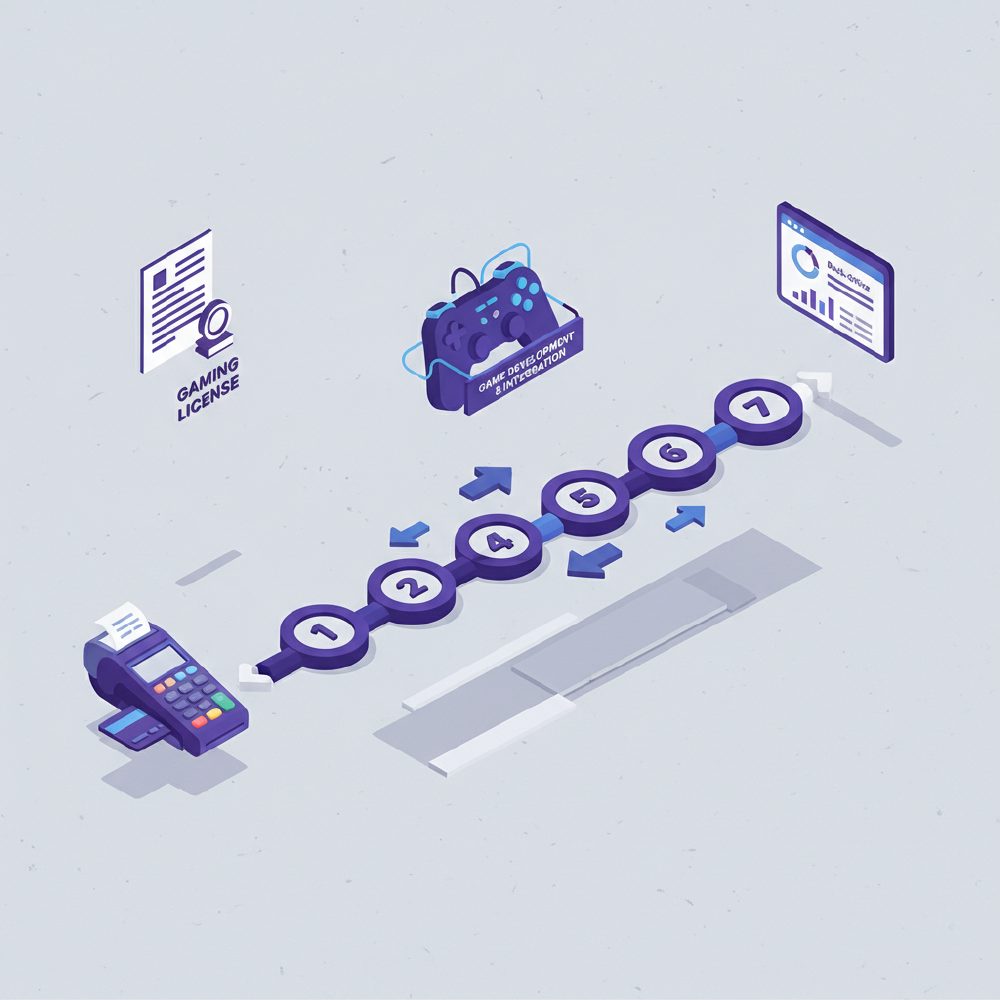
What does the 7-step white label casino launch process look like end to end?
The seven steps are: define your market and model, choose a jurisdiction and begin licensing, select a platform provider, configure your game library and payment stack, build your brand and website, complete compliance setup and testing, then go live with a controlled soft launch. Done sequentially and without delays, this takes 8–16 weeks for an offshore white label.
Step 1 — Define your target market and business model. This sounds obvious but most operators skip it. Which country or region are you targeting? What's your primary acquisition channel — SEO, affiliates, paid social, influencer? What's your player value proposition — crypto-friendly, high-bonus, niche vertical? These answers determine your license choice, payment stack, and game mix. Changing direction after you've signed a platform contract is expensive.
Step 2 — Choose your jurisdiction and begin the license application. For most offshore white labels in 2026, Curaçao CGOA or Anjouan. File early — even if your platform isn't selected yet. License processing is the longest single-threaded dependency in your critical path. Use a licensed local representative firm; don't try to navigate the CGOA's new application portal without local agent support.
Step 3 — Select and contract your platform provider. Issue an RFP to three or four providers (SoftSwiss, EveryMatrix, Turnkey Casino, BetConstruct depending on your vertical). Compare on revenue share structure, included game studios, payment integrations, back-office quality, and support SLAs. Negotiate the revenue share — first-offer terms are rarely final.
Step 4 — Configure your game library and payment stack. Work with your platform provider to activate the game studios relevant to your market. Simultaneously apply for merchant accounts with two or three acquiring banks — don't rely on a single acquirer. Set up crypto payment processing if relevant. This step runs in parallel with Step 3 and Step 5.
Step 5 — Build your brand and website. Your platform provider supplies the casino engine; you supply the brand. This means logo, color palette, UI customization within the platform's design constraints, and all player-facing copy (terms and conditions, bonus terms, privacy policy). Don't underestimate the T&C work — your bonus terms need to be legally reviewed for your jurisdiction. Budget $3,000–$8,000 for a proper brand and design package if you're not doing it in-house.
Step 6 — Complete compliance setup and pre-launch testing. Configure KYC thresholds, AML monitoring rules, responsible gambling controls, and geo-blocking for restricted jurisdictions. Run a full QA pass on the deposit/withdrawal flow, game loading, and mobile responsiveness. Test every bonus mechanic manually — platform bugs in bonus wagering calculations are more common than vendors admit.
Step 7 — Soft launch and controlled ramp-up. Go live with a restricted player pool — affiliates, beta testers, or a small paid traffic campaign. Monitor payment conversion rates, KYC pass rates, and game load times obsessively for the first two weeks. Fix before you scale. Most operators who fail do so because they scaled marketing spend before the product was actually working.
What are the most common mistakes operators make when launching a white label casino?
The three mistakes I see most often: signing a revenue-share deal without modeling the long-term cost, launching without a working payment method in the target market, and underestimating the time and cost of licensing. Each of these alone can kill a launch. Together, they usually do.
Revenue share blindness is endemic in white label launches. A 35% GGR revenue share sounds acceptable when you're projecting $20,000/month GGR in your business plan. At $200,000/month GGR — which is a modest success — that's $70,000/month leaving your business every month, forever. Operators who grow into their white label deals often find themselves trapped: migrating to a turnkey or custom platform mid-operation is expensive and risky, and the platform provider knows it. Negotiate a revenue share step-down clause — e.g., the rate drops from 35% to 25% above $100,000/month GGR — before you sign.
Payment failures are quieter but equally lethal. I've reviewed launches where the operator went live with only Visa/Mastercard processing and no local payment method, targeting a market where 40% of players prefer bank transfer or e-wallet. The traffic arrived, the players registered, and then they left without depositing because their preferred payment method wasn't available. Payment integration is not a post-launch task. It is a launch prerequisite.
Licensing timeline underestimation creates a specific trap: operators sign the platform contract, start paying monthly minimums, and then wait months for their license. During that wait, they're spending money with no revenue. Always start the license application before or simultaneously with platform selection, not after. And don't assume the platform provider's claim that their master license covers your operation is accurate under the new CGOA framework — get written confirmation from a local licensing attorney, not just the vendor's sales team.
One more that deserves a mention: launching with generic bonuses. A 100% match up to $200 welcome bonus is identical to 500 other white label casinos. Bonus differentiation — whether that's a no-wagering cashback model, a crypto reload structure, or a VIP program with genuine perks — is one of the few levers a white label operator has to stand out. Think about your bonus strategy before launch, not as an afterthought.
How does white label casino integration actually work technically?
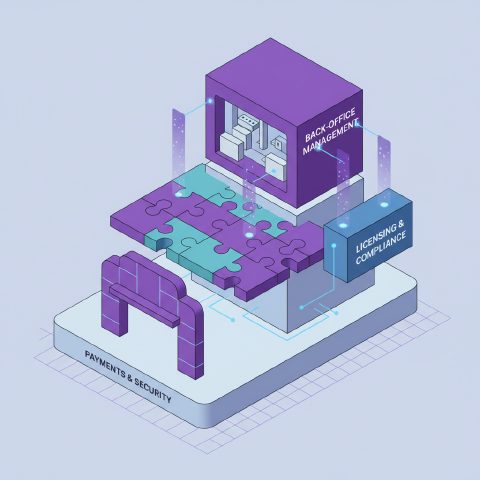
White label casino integration is primarily handled server-side by the platform provider. As an operator, you configure your brand, payment methods and game selection through a back-office dashboard — you don't write code. The technical complexity is in the payment gateway integrations and any custom front-end work you want beyond the platform's default templates.
Most white label platforms expose operator configuration through a web-based back-office portal. You set up payment methods, configure bonus rules, manage player accounts, and pull reporting — all without touching an API. The platform's integration team handles the underlying connections to game studios, payment processors, and KYC providers. This is the core value proposition of white label: the technical plumbing is pre-built.
Where technical work does fall to the operator is front-end customization. Platforms like SoftSwiss and EveryMatrix offer templated casino skins that you customize with your brand assets, color scheme, and content. Some platforms allow deeper front-end customization via their own theming system or a headless API mode where you build a custom front-end that calls their game and account APIs. Headless integration gives you full design freedom but requires a front-end development team and adds 4–8 weeks to your timeline.
Payment gateway integration is the other area where operator-side technical work is sometimes required. If your chosen acquirer isn't pre-integrated with the platform, you'll need the platform's payment API documentation and a developer to build the integration. This is more common with regional acquirers and crypto processors. Budget 2–4 weeks for a new payment integration if it's not already in the platform's library.
On the analytics and data side, white label back-offices vary significantly in quality. SoftSwiss has a mature reporting suite. Smaller providers often have thin reporting that makes player LTV analysis and cohort tracking difficult. If data-driven marketing is central to your strategy, ask for a back-office demo focused specifically on reporting capabilities — not the game lobby — before signing.



Comments
No comments yet, be the first.