White Label Casino Solutions: The Operator's Full Guide to Launching Smart in 2026
What exactly is a white label casino solution and how does it differ from a turnkey build?
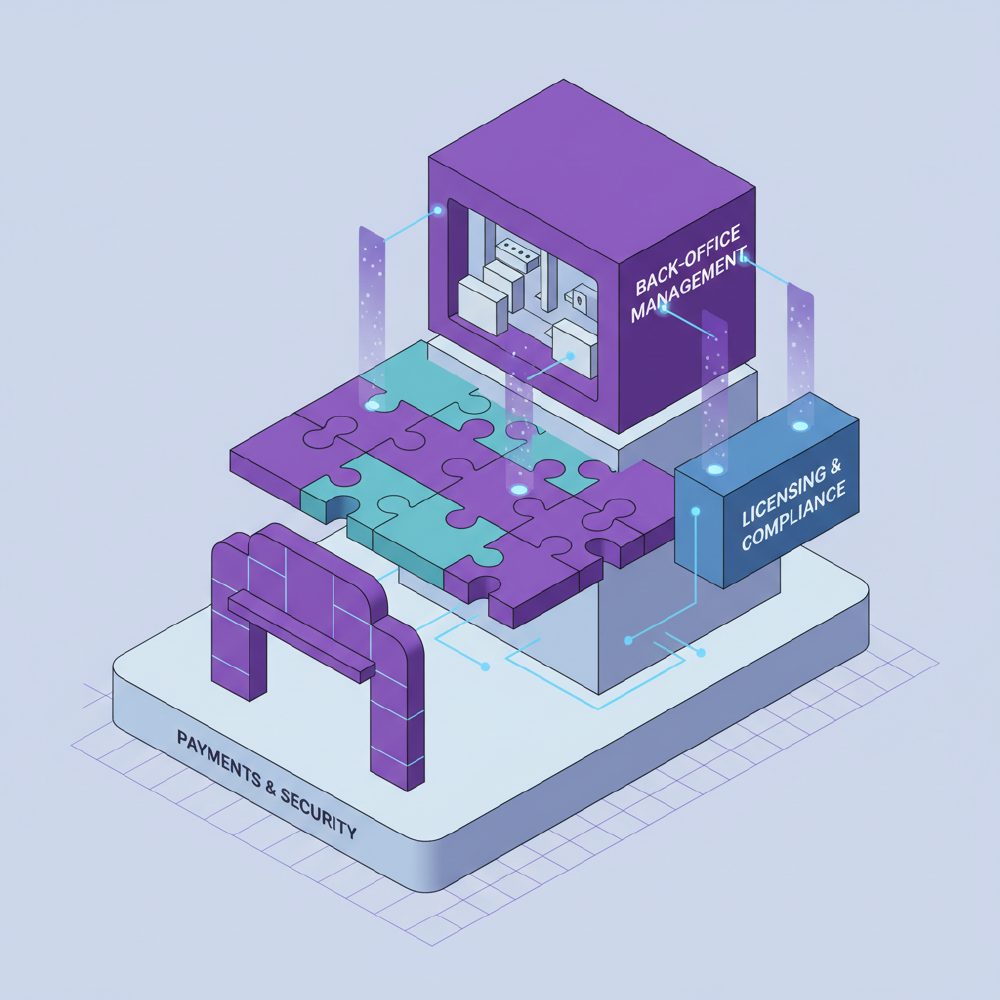
A white label casino is a pre-built gambling platform — games, back-office, payments, CRM — that you rebrand and operate under your own name. The infrastructure is owned and maintained by the provider. A turnkey build gives you more of the same stack but typically transfers more operational control, and sometimes the licence, directly to you. The line between them has blurred in 2025–2026, but the ownership of the licence is usually the clearest dividing line.
In a pure white label arrangement, the platform provider holds the gambling licence (or sub-licences you under their master licence), manages server infrastructure, handles game certification and takes responsibility for regulatory compliance at the platform level. You supply the brand, the marketing budget and the player acquisition strategy. The provider takes a revenue share — commonly 15–30% of GGR — plus a setup fee that typically ranges from €10,000 to €60,000 depending on the provider and the market.
Turnkey solutions sit one step further along the control spectrum. Providers like SoftSwiss's turnkey offering or EveryMatrix's full-stack CardsChat-style build will hand you a configured platform, but you apply for your own licence and own the back-office data outright. You pay a platform fee (often a lower rev-share of 10–20% or a flat SaaS model) rather than operating under someone else's licence umbrella. That distinction matters enormously for brand equity: if you ever want to sell the business, a white label operation where the licence belongs to the provider is worth far less to an acquirer than a fully licensed entity you own.
There's a third category worth naming — the managed white label, where the provider also runs CRM, bonusing and even customer support. Companies like Aspire Global (now part of Paysafe's gaming division) and Income Access have offered variants of this. It's attractive for first-time operators who have capital but no iGaming ops experience, but the rev-share can climb to 35–40% once you add managed services, which is punishing at scale.
My honest take: white label is the right move for operators who want to test a market with limited capital and no existing tech team. If you're projecting more than €800K GGR per month within 18 months, model out the turnkey or proprietary path seriously — the rev-share math stops working in your favour faster than most vendors will admit.
| Factor | White Label | Turnkey | Proprietary Build |
|---|---|---|---|
| Time to launch | 6–16 weeks | 3–6 months | 12–24 months |
| Upfront cost (est.) | €10K–€60K | €50K–€200K | €500K–€2M+ |
| Ongoing cost | 15–35% GGR rev-share | 10–20% GGR or flat SaaS | Hosting + staff + maintenance |
| Licence ownership | Provider holds it | Operator holds it | Operator holds it |
| Customisation | Limited (skin-level) | Moderate | Full |
| Data ownership | Shared / restricted | Full | Full |
| Best for | Market testing, lean teams | Scaling operators | Established groups |
Which white label casino platforms are operators actually shortlisting in 2026?
SoftSwiss, EveryMatrix, Delasport, Tain and BtoBet are the five names that appear most consistently in serious operator RFPs right now. Each has a different strength: SoftSwiss leads on crypto-native infrastructure, EveryMatrix on aggregation depth, Delasport on sports-casino convergence, Tain on Scandinavian market expertise and BtoBet on emerging markets. No single platform is best — the right choice depends on your target geography and product mix.
SoftSwiss has arguably the strongest brand recognition in the white label space, partly because of its early dominance in the crypto casino segment. Their Casino Management System (CMS) supports over 60 currencies including crypto, and their game aggregator pulls from 200+ studios. For operators targeting crypto-forward audiences in LATAM or Asia-Pacific, SoftSwiss is a natural starting point. Setup fees in 2024–2025 were typically in the €15K–€40K range depending on configuration, with rev-share starting around 15%. They also provide Curaçao sub-licences through their master licence, which accelerates offshore launches significantly.
EveryMatrix takes a modular approach through its EvenBet, CasinoEngine and MoneyMatrix products. You can license individual modules rather than the full stack, which is useful if you already have a payment layer you trust or a sports betting solution you want to retain. Their game aggregation through CasinoEngine is genuinely one of the deepest in the market — 20,000+ titles from 200+ providers as of early 2025. The trade-off is integration complexity; their API documentation is thorough but the initial integration timeline is longer than SoftSwiss's out-of-the-box white label.
Delasport is worth serious attention if your roadmap includes sportsbook alongside casino. Their unified wallet and single-API approach to sports and casino reduces the operational friction that plagues operators running separate platforms. They're particularly active in Eastern Europe and have MGA-compliant configurations. BtoBet, now under Kambi Group, similarly targets the sports-led operator but has deeper emerging market penetration — Colombia (Coljuegos-compliant), Peru (MINCETUR) and several African markets where they've done actual regulatory groundwork rather than just claiming compatibility.
Tain is less talked about in global circles but has a loyal base of Scandinavian operators. Their platform is mature, their compliance layer for Swedish SGA requirements is well-tested, and their support is genuinely responsive — something that matters more than it sounds when you're trying to resolve a payment issue at 2am on a Saturday. For operators targeting the Nordics, Tain deserves a spot in any shortlist.
| Provider | Best Market Fit | Game Aggregation | Crypto Support | Sportsbook Included | Approx. Setup Fee |
|---|---|---|---|---|---|
| SoftSwiss | Crypto, offshore, LATAM | 200+ studios | Yes (native) | Via partner | €15K–€40K |
| EveryMatrix | EU, multi-vertical | 200+ studios, 20K+ titles | Partial | Via OddsMatrix | €20K–€60K |
| Delasport | Eastern EU, sports-led | 150+ studios | Limited | Yes (native) | €25K–€50K |
| BtoBet / Kambi | LATAM, Africa, sports-led | 100+ studios | Limited | Yes (native) | €30K–€70K |
| Tain | Nordics, EU | 120+ studios | No | No | €10K–€30K |
What does a white label casino actually cost to launch and operate?
Realistically, budget €30,000–€120,000 to get a white label casino live — covering setup fees, initial licensing costs, payment integration, content and working capital. The number that will define your P&L long-term, though, is the revenue share: at 20% GGR on €500K monthly gross, you're paying €100K per month to your platform provider before a single other operating expense. Most operators underestimate this compounding cost badly.
The setup fee is the visible cost — the one in the proposal deck. It covers platform configuration, skin design, game library activation and basic payment integration. Expect €10K–€60K from most established providers. What's not in that line item: the cost of your gambling licence (Curaçao e-Gaming sub-licence runs €5K–€15K in application fees plus annual fees; Anjouan is cheaper but less respected by payment processors; MGA costs €25K+ in application fees alone and takes 6–12 months). Add KYC/AML tooling (Sumsub, Onfido, Jumio — typically €0.50–€3 per verification), responsible gambling tools mandated by most regulators, and a payment processing setup that actually works.
Payment integration is where operators consistently bleed money they didn't budget for. Most white label providers include one or two PSPs in their standard package — often a generic solution that works for card payments but has poor conversion in specific geographies. If you're targeting Brazil, you need Pix integration; Mexico requires SPEI; Germany's player base increasingly demands local bank transfer options. Each additional PSP integration can cost €2K–€10K in setup fees from the PSP side, and some white label providers charge additional fees to connect PSPs outside their approved list. Budget €15K–€40K for a payment stack that actually converts across your target markets.
Ongoing operational costs beyond the rev-share include: affiliate management (platform fee for tools like Income Access or MyAffiliates, plus affiliate commissions of 25–45% CPA or rev-share), customer support (either in-house at €3K–€15K/month or outsourced), and marketing. A realistic monthly burn rate before player revenue for a lean white label operation is €20K–€50K. Many first-time operators launch with €100K total and wonder why they're out of cash in month three.
The rev-share cliff is real. At €1M monthly GGR, a 20% rev-share means €200K going to your platform provider. A turnkey licence with a flat SaaS fee of €15K–€25K/month plus a 10% rev-share would cost €115K–€125K at the same volume — saving €75K–€85K monthly. That delta funds a significant tech team or a meaningful marketing budget. Run the numbers at your realistic 18-month GGR projection before signing a long-term white label contract.
Which gambling licences work with white label casino solutions and which don't?
Curaçao and Anjouan are the most white-label-friendly jurisdictions because they allow sub-licensing under a master licence — your platform provider can add you to their existing licence in weeks. MGA (Malta), UKGC and most regulated EU licences require the operator to hold their own licence and the platform to hold a separate B2B certification, which makes pure white label structurally harder and more expensive.
Curaçao's 2023 gaming reform introduced the National Ordinance on Offshore Games of Hazard (NOOGH), which created a new licensing framework that came into full effect through 2024–2025. Under the new system, master licences were replaced by direct operator licences issued by the Curaçao Gaming Control Board (GCB). This matters for white label operators: the old model of riding under a provider's master licence is being phased out. By 2026, most Curaçao-licensed white label operators will need their own licence — a process that takes roughly 3–6 months and costs €20K–€40K including advisory fees. Providers like SoftSwiss are adapting their offering accordingly.
Anjouan (Comoros) has emerged as an alternative for operators who find even the reformed Curaçao process too slow or expensive. Anjouan licences are cheaper (often €5K–€12K) and faster (sometimes 4–8 weeks), but the jurisdiction is less recognised by tier-1 payment processors. You'll have more difficulty getting Visa/Mastercard acquiring under an Anjouan licence compared to Curaçao — most Anjouan operators rely heavily on crypto payments and alternative PSPs. It's a viable route for crypto-native operations; it's not a serious path if you need card processing volume.
For EU-regulated markets, the white label model hits structural limits. The MGA requires both the operator (B2C licence) and the platform provider (B2B Critical Gaming Supply licence) to be independently licensed. EveryMatrix, SoftSwiss and Delasport all hold MGA B2B licences, so they can supply to MGA-licensed operators. But you, as the operator, still need your own MGA B2C licence — a process that takes 6–12 months and costs €25,000+ in application fees plus ongoing compliance costs. The white label provider can't shortcut that. Same logic applies to Sweden (SGA), Denmark (DGA) and Germany (GGL). For these markets, white label reduces your tech burden but doesn't reduce your regulatory burden.
LATAM is a patchwork. Colombia (Coljuegos) and Peru (MINCETUR) require local entity incorporation and direct operator licences — no sub-licensing shortcuts. Mexico operates under federal SEGOB licences that are notoriously difficult to obtain and rarely granted to new entrants; most 'Mexico-focused' operations run offshore. Brazil's regulatory framework under SECAP/MF came into effect in 2025, creating a new licensed online betting market — the first applications were processed through 2025 with ongoing licence grants into 2026. White label providers are scrambling to certify their platforms for Brazilian compliance, and the field is not settled yet.
| Jurisdiction | Regulator | White Label Friendly? | Est. Timeline | Est. Operator Cost |
|---|---|---|---|---|
| Curaçao | GCB | Yes (own licence now required) | 3–6 months | €20K–€40K |
| Anjouan | AGSC | Yes | 4–8 weeks | €5K–€15K |
| Malta | MGA | Partial (B2B cert required) | 6–12 months | €25K–€60K+ |
| UK | UKGC | No (own licence mandatory) | 6–18 months | £50K–£150K+ |
| Sweden | SGA | No (own licence mandatory) | 6–12 months | €30K–€80K+ |
| Colombia | Coljuegos | No (local entity + licence) | 12–24 months | $100K+ USD |
| Brazil | SECAP/MF | Evolving (2025–2026 rollout) | TBC | TBC |
How long does it take to launch a white label casino from contract to go-live?
With an offshore licence already in hand or sub-licensing through a provider, a white label casino can go live in 6–12 weeks. Add the licensing process and you're looking at 3–6 months for Curaçao, 6–12 months for MGA. The technical build is rarely the bottleneck — payment integration, KYC tool setup and content licensing agreements cause most delays.
The platform configuration itself — skin design, game library activation, back-office setup — takes 2–4 weeks with most established providers once you've signed contracts and provided brand assets. SoftSwiss, for example, has a documented onboarding process that gets operators to a staging environment within 3 weeks for standard configurations. EveryMatrix is slightly slower on initial setup due to their modular architecture but offers more flexibility once live. Where timelines slip is in the dependencies that sit outside the platform provider's control.
Payment integration is the most common delay. Getting a PSP to approve your account requires submitting corporate documents, a business plan, responsible gambling policies, proof of licensing and often a sample of your marketing materials. PSPs that specialise in gambling — Payvision, Nuvei, PaySafe — have compliance teams that move at their own pace. Expect 3–6 weeks per PSP from application to live processing, and apply to multiple simultaneously. If your licence isn't finalised, most tier-1 PSPs won't even start the review. This creates a sequencing problem: you need the licence to get the PSP, but you need the PSP to have a viable product.
KYC and AML tool integration adds another 1–3 weeks. Providers like Sumsub and Onfido have well-documented APIs, but configuring the verification flows, setting risk thresholds and testing edge cases (document types, selfie matching failure rates) takes time. Regulators increasingly audit KYC configuration at licence application stage — a poorly configured KYC flow can delay your licence approval, not just your launch.
My practical advice: treat the 12-week timeline as the optimistic scenario where everything goes right. Build a 20-week project plan, identify your critical path dependencies (licence → PSP approval → KYC go-live), and start parallel workstreams on day one. Operators who wait for the licence before approaching PSPs routinely add 6–8 weeks to their launch timeline for no good reason.
What games and software providers come with a white label casino solution?
Most white label platforms aggregate content from 100–200+ game studios through a single API, giving you access to slots, live casino, table games and increasingly sports betting from day one. The critical question isn't how many providers are available — it's which studios are certified for your target market, and whether premium live casino content (Evolution, Pragmatic Live) is included or costs extra.
Game aggregation is one area where white label genuinely delivers value. Building direct integrations with 50 game studios independently would take 12–18 months and significant developer resource. A white label platform gives you that library on day one. SoftSwiss's aggregator includes titles from Pragmatic Play, NetEnt, Play'n GO, Hacksaw Gaming, Nolimit City and 200+ others. EveryMatrix's CasinoEngine claims 20,000+ titles from 200+ providers. The raw numbers are less important than the specific studios — players in different markets have strong preferences, and missing a key local favourite hurts conversion.
Live casino is where the content economics get complicated. Evolution Gaming dominates live casino globally, and their content is expensive — Evolution charges operators a minimum monthly fee (often €10K–€30K depending on table configuration) plus a rev-share on live casino GGR. Some white label providers include Evolution access in their package; others treat it as an add-on with pass-through costs. Pragmatic Play Live is a more affordable alternative with solid product quality, and it's included in more standard white label packages. If live casino is central to your product strategy, get explicit clarity on Evolution access and cost before signing.
Market certification matters more than most operators realise at the proposal stage. A game studio might have 500 titles in their portfolio, but only 200 of those are certified for MGA, and perhaps 150 for the Swedish SGA. When you're building your lobby for a specific regulated market, the effective game library can be significantly smaller than the headline number suggests. Ask your platform provider for a certified-for-your-jurisdiction game count, not total portfolio size.
Crash games, virtual sports and live game shows have grown significantly as content categories through 2024–2025. Providers like Spribe (Aviator), BGaming and Smartsoft Gaming have strong player engagement metrics in LATAM and Eastern European markets. If your target audience skews younger or is coming from a sports betting background, weighting your lobby toward these categories can meaningfully improve session length and deposit frequency. Most white label platforms now include these studios, but check specifically.
How do payments and withdrawals work on a white label casino platform?
White label platforms include a payment layer — typically a payment orchestration module that routes transactions through pre-integrated PSPs. The provider's existing PSP relationships are a genuine advantage at launch. The limitation is that you're dependent on the provider's approved PSP list, and adding PSPs outside that list often requires additional integration fees and provider approval.
Most established white label providers have pre-integrated 20–50 PSPs covering cards (Visa, Mastercard), bank transfers, e-wallets (Skrill, Neteller, PayPal in select markets) and crypto. SoftSwiss's MoneyMatrix — now a standalone EveryMatrix product after a corporate restructuring — is one of the more sophisticated payment orchestration layers in the market, with intelligent routing that can improve card approval rates by directing transactions to the PSP most likely to approve based on BIN, country and amount. This kind of routing logic takes years to build independently; getting it out of the box is a real white label advantage.
The practical limitation surfaces when you need PSPs that aren't on the provider's approved list. If you're targeting Brazil and need Pix integration with a specific local acquirer, or if you want to add a crypto payment processor that the provider hasn't integrated, you'll face a queue. Providers prioritise integrations that benefit multiple clients simultaneously. Your request for a single-market PSP might wait 3–6 months. Some providers allow you to bring your own PSP integration via their API, but this typically requires technical resource on your side and an additional integration fee.
Fraud and chargeback management is another area where the white label model creates shared risk. If another operator on the same platform has poor fraud controls and drives up chargeback rates, it can affect the PSP relationship for the entire platform. This is rare with reputable providers who enforce minimum fraud standards across their client base, but it's a risk worth asking about explicitly — specifically, whether PSP accounts are shared or segregated per operator.
Crypto payments deserve specific mention for 2026. Bitcoin, Ethereum, USDT and increasingly USDC are standard payment options on most offshore white label platforms. SoftSwiss in particular has deep crypto infrastructure. For operators targeting crypto-native audiences, the ability to offer instant crypto withdrawals is a meaningful competitive differentiator. Fiat-to-crypto conversion at the platform level (so players can deposit in fiat and play against a crypto back-end) is also available from several providers, though the FX spread on these conversions can be an implicit cost to players that affects satisfaction.
Can you launch a white label casino targeting US players in 2026?
No — not legally, and not practically with a reputable platform. US real-money online casino is regulated state by state, and operating without a state licence exposes you to federal Wire Act liability. The few states with legal iGaming (New Jersey, Pennsylvania, Michigan, Delaware, West Virginia, Connecticut) require partnerships with land-based licensees and full state approval — there is no offshore shortcut that a serious operator should take.
The US iGaming market is genuinely exciting — New Jersey alone generates over $2 billion in annual online casino GGR — but the regulatory structure makes white label in the traditional offshore sense impossible. Each state that has legalised online casino requires the operator to either hold a state licence directly or operate as a skin on a licensed platform that has an existing partnership with a land-based casino licence holder (called a 'tethered' model in most state frameworks). Pennsylvania, Michigan and New Jersey all operate on this model.
What this means in practice: if you want to enter the US market, you need to partner with an existing land-based licensee, apply for a state interactive gaming licence (a process that takes 12–24 months in most states and involves extensive background checks on all principals), and use a platform that is already certified in that state. Scientific Games (now Light & Wonder), IGT, Everi and GAN are the dominant B2B platform providers in the US regulated space. European white label providers like SoftSwiss and EveryMatrix are largely absent from US regulated markets because the certification process is expensive and time-consuming.
Offshore operators targeting US players without a state licence do exist — they're operating illegally under US federal law and are tolerated only because enforcement prioritises the largest operators. This is not a business strategy; it's a liability. Payment processing for US players without a state licence is increasingly difficult as banks and card networks have tightened compliance. The operators running this model rely on crypto payments and offshore payment processors, and they face constant disruption to their payment stack.
If you have genuine US ambitions, the realistic path is: identify a target state, find a land-based partner willing to sponsor your licence application, engage a US gaming attorney (not a general corporate lawyer — someone who specifically does gaming regulatory work), and budget 18–36 months and $500K–$2M+ for the process. It's a high-barrier market precisely because the margins for licensed operators are strong. There is no white label shortcut.
What are the biggest risks and failure modes operators discover too late with white label casino?
The three most common failure modes are: choosing a platform based on demo quality rather than operational reliability, signing a long-term revenue share contract without exit clauses, and launching without a realistic player acquisition budget. The platform is the smallest of your problems — acquiring players profitably is what actually determines whether you survive past month six.
Platform reliability under load is something you can't fully evaluate from a sales demo. Ask prospective providers for uptime SLAs (99.9% is the minimum you should accept), incident response times and — critically — references from operators you can actually call. Providers will give you references; call them and ask specifically about outages, payment processing failures and support responsiveness during incidents. The difference between a provider whose support answers in 15 minutes and one that takes 4 hours matters enormously when your casino is down on a Saturday night.
Contract terms are where experienced operators have scars. Revenue share agreements with 3–5 year terms and no exit clauses are common in the white label space. If your business doesn't scale as projected, you're locked into a high rev-share rate on a small volume — which is expensive. If your business scales dramatically, you're locked into a rev-share that's costing you far more than a turnkey alternative would. Negotiate for: a tiered rev-share that decreases as GGR increases, an exit clause after 12–18 months with reasonable notice, and data portability provisions so you can migrate your player database if you switch platforms. Most providers will push back; some will agree to partial concessions. A gaming lawyer reviewing the contract before signing is worth every euro.
Player acquisition is the existential risk that no platform vendor will mention. Your white label casino will have zero players on day one. Acquiring players profitably in a market dominated by large operators with established affiliate networks and significant marketing budgets is genuinely hard. Affiliate CPA rates in competitive markets (UK, Germany, Sweden) run €150–€400 per depositing player. In emerging markets like Brazil or Peru, rates are lower but traffic quality is more variable. Operators who launch with €50K in marketing budget and expect to be profitable in three months are setting themselves up for failure. A realistic player acquisition budget for a viable offshore operation is €100K–€300K for the first six months, with no guarantee of profitability in that window.
Bonus abuse and fraud are operational risks that catch new operators off-guard. Welcome bonuses attract bonus hunters who have no intention of becoming genuine players. Without proper wagering requirements, game restrictions and velocity checks, a poorly designed bonus structure can generate significant bonus cost with minimal genuine player LTV. Your white label provider's CRM and bonus engine should include tools to identify and limit bonus abuse — ask specifically about this capability before launch, and set conservative bonus terms initially until you understand your player base.
How does the white label casino model handle responsible gambling and AML compliance?
Reputable white label providers build responsible gambling tools and AML monitoring into the platform — deposit limits, self-exclusion, session limits, reality checks and transaction monitoring. The operator remains legally responsible for compliance even when the platform provides the tooling. Regulators will hold you accountable for failures regardless of what your platform contract says.
Responsible gambling (RG) tooling has become table stakes for any platform operating in regulated or semi-regulated markets. Standard features include: player-set deposit limits (daily, weekly, monthly), loss limits, session time limits, reality checks (pop-up notifications of time and money spent), cool-off periods and self-exclusion. MGA-licensed operators must also integrate with the national self-exclusion register; Swedish SGA requires Spelpaus integration; the UKGC mandates affordability checks for high-value depositors. Your white label provider should have these integrations built — verify specifically which national exclusion registers they're connected to for your target markets.
AML compliance is an area where operators frequently underinvest in the belief that the platform handles it. The platform provides transaction monitoring tools — flagging unusual deposit patterns, structuring behaviour, and high-risk jurisdictions. But the operator is responsible for acting on those flags: conducting enhanced due diligence, filing suspicious activity reports (SARs) with the relevant financial intelligence unit, and maintaining audit trails. This requires a designated AML officer (a real person, not a job title assigned to the CEO) and documented policies. Regulators audit this, and fines for AML failures in regulated markets are significant — the MGA has levied fines of €100K–€500K for AML compliance failures.
Problem gambling detection is increasingly sophisticated and increasingly mandated. Tools that identify behavioural markers — sudden increases in deposit frequency, session length changes, repeated failed withdrawal requests — are now expected by regulators. Providers like Behavioural Signals and BetBlocker offer third-party tools that integrate with most white label platforms. Budget for this; it's not optional in regulated markets and it's increasingly expected even in offshore jurisdictions that want to maintain banking relationships.
What should operators negotiate before signing a white label casino contract?
The five terms worth fighting for are: a tiered revenue share with volume-based reductions, a data portability clause, an exit provision after 12–18 months, clarity on PSP account segregation, and explicit SLAs with financial penalties for downtime. Most providers' standard contracts favour the provider heavily — almost everything is negotiable if you're bringing meaningful projected volume.
Revenue share structure is the highest-value negotiation. Standard contracts offer a flat rate — say, 20% of GGR — regardless of your volume. Push for a tiered structure: 20% below €200K monthly GGR, 17% from €200K–€500K, 14% above €500K. Providers who believe in your volume projections will agree to this; those who don't will resist. The negotiation itself is informative. Also clarify what 'GGR' means in the contract — some providers calculate it before bonus costs (gross GGR), others after (net GGR). The difference is significant if you're running aggressive welcome bonuses.
Data portability is non-negotiable from a business continuity standpoint. Your player database — KYC documents, transaction history, player preferences, contact details — is your primary asset. The contract should explicitly state that this data belongs to you, that you can export it in a standard format (CSV, JSON) on request, and that the provider will cooperate with a platform migration if you choose to leave. Contracts that are silent on data portability or that treat player data as belonging to the provider are a red flag. If you ever sell the business or migrate to a proprietary platform, you need this data.
SLAs with financial teeth are worth the negotiation effort. A 99.9% uptime SLA sounds good but is meaningless without a financial remedy for breaches. Push for service credits — typically a percentage of the monthly platform fee — for downtime exceeding the SLA threshold. Also negotiate response time SLAs for critical issues (payment processing failures, full platform outages) separately from general support tickets. A commitment to 15-minute response for P1 incidents versus 4 hours makes a real operational difference.
Finally, get clarity on the provider's right to terminate. Some white label contracts give the provider the right to terminate with 30 days' notice for broadly defined 'reputational risk' or 'regulatory concerns.' This is a significant business risk — your entire operation can be shut down at the provider's discretion. Negotiate for longer notice periods (90–180 days), defined termination triggers, and a wind-down period that gives you time to migrate players to a new platform.




Comments
No comments yet, be the first.