Casino Management System for Online Casinos: The Operator's Complete Guide for 2026

What is a casino management system and what does it actually do?
A casino management system is the administrative and operational platform that sits behind the player-facing casino website. It manages player accounts, session data, bonus engines, payment processing, compliance reporting, and customer support tooling. Think of it as the ERP of an online casino — the games are the product, the CMS is everything that makes the business run.
The term gets used loosely in vendor decks, so let's be precise. A CMS does not serve game content — that is the job of a game aggregator like Relax Gaming Hub or SoftSwiss Game Aggregator (SGFA). The CMS wraps around the game layer and handles the operator's actual business logic: who is this player, what are they allowed to do, what bonus are they eligible for, have they hit a responsible gambling limit, and has the transaction been flagged for AML review. It is the system of record for your entire operation.
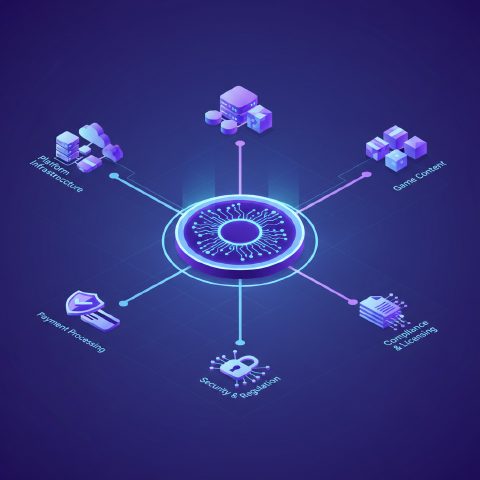
Core modules in any production-grade CMS include player account management (PAM), a bonus and promotion engine, a payment processing layer or gateway integration hub, KYC/AML workflow management, real-time reporting and analytics, an affiliate management system, and customer support (CRM) tooling. Some vendors bundle all of these; others sell them as modular add-ons. EveryMatrix's OrchestraOS, for instance, separates its PAM (PlayerIQ) from its bonus engine (BonusIQ) and lets operators license them independently — useful if you already have a working bonus tool and don't want to pay for a duplicate.
The CMS also serves as the compliance interface. When an MGA or Curaçao GCB auditor asks for a player's full transaction history, session logs, or self-exclusion records, your CMS is what generates that report. If the system cannot produce clean, timestamped audit trails, you have a licensing problem. This is not theoretical — operators have had licenses suspended because their CMS vendor's reporting module was inadequate, not because of anything the operator did wrong operationally.
One distinction worth drawing early: a CMS is different from a full turnkey or white-label platform. A white-label platform (like those offered by SoftSwiss or Income Access) bundles CMS, game content, payments, and often a front-end template into a single commercial package. A standalone CMS purchase assumes you are sourcing games, payments, and front-end separately. Both models are legitimate; the right choice depends on how much control you want and how much integration work you can absorb.
What are the core modules every online casino management system must include?
At minimum, a production-ready casino management system needs a player account management (PAM) layer, a configurable bonus engine, a payment orchestration hub, KYC/AML workflow tools, real-time reporting, and responsible gambling controls. Missing any one of these is not a gap you patch post-launch — it is a compliance liability and a revenue leak from day one.
The PAM is the foundation. Every player action — registration, deposit, wager, withdrawal, self-exclusion — needs to be written to a single authoritative record. Weak PAM architectures create duplicate accounts, broken bonus eligibility logic, and reconciliation nightmares at month-end. When evaluating vendors, ask specifically how the PAM handles concurrent sessions across mobile and desktop, and how it enforces jurisdiction-specific deposit limits in real time rather than batch-processing them overnight.
The bonus engine is where operators lose the most money to misconfiguration. A proper bonus engine needs to support wagering requirements, game contribution weights, max bet rules, time-limited offers, free spin campaigns, and cashback — and it needs to enforce all of these rules at the transaction level, not just at withdrawal. SoftSwiss's bonus engine, for example, enforces max bet rules mid-session, which is what regulators like the UK Gambling Commission and MGA now require. Vendors that only check eligibility at withdrawal create both a player dispute risk and a regulatory risk.
Responsible gambling (RG) tools are no longer optional in any serious jurisdiction. The CMS must support deposit limits, loss limits, session time limits, reality checks, self-exclusion (including GAMSTOP integration for UK operators), and cooling-off periods. The MGA's Player Protection Directive and Sweden's Spelinspektionen framework both mandate specific RG controls that must be enforced at the CMS level. If a vendor cannot show you a live demo of these controls working end-to-end, move on.
Reporting and analytics deserve more scrutiny than they typically get in vendor demos. You need gross gaming revenue (GGR) reports by game, provider, player segment, and geography — ideally in real time, not T+1. You also need reconciliation reports that match your payment processor settlements to your CMS transaction ledger. Discrepancies here are how fraud hides. Platforms like EveryMatrix and Digitain have invested heavily in BI tooling; some smaller vendors still ship Excel exports and call it reporting.
| Module | Primary Function | Key Compliance Driver | Common Weak Points |
|---|---|---|---|
| Player Account Management (PAM) | Single record for all player activity and state | MGA, GCB, US state audits | Duplicate accounts, async limit enforcement |
| Bonus Engine | Manages promotions, wagering requirements, free spins | UKGC max-bet rules, MGA bonus terms | Withdrawal-only checks, misconfigured game weights |
| Payment Orchestration | Routes deposits/withdrawals across PSPs and crypto | AML, PCI DSS, local payment mandates | Single-PSP dependency, slow reconciliation |
| KYC/AML Workflow | Identity verification, PEP/sanctions screening, EDD | FATF, local AML laws, Curaçao GCB | Manual bottlenecks, no automated re-screening |
| Responsible Gambling Tools | Limits, self-exclusion, reality checks, GAMSTOP | MGA Player Protection, Spelinspektionen | Batch enforcement, missing GAMSTOP integration |
| Reporting & Analytics | GGR, player value, reconciliation, regulator exports | License audit requirements | T+1 delays, no reconciliation against PSP settlements |
| Affiliate Management | Tracks referrals, calculates CPA/RevShare commissions | Advertising regulations by jurisdiction | Inaccurate attribution, no fraud detection |
How does a casino management system differ from a white-label platform?
A white-label platform bundles CMS, game content, payment integrations, and often a front-end template into one commercial package — you are renting an entire operation. A standalone CMS is just the back-office layer; you source and integrate games, payments, and front-end separately. The distinction matters enormously for cost, control, and time-to-market.
White-label platforms like SoftSwiss Casino Platform, EveryMatrix's full-stack offering, or Turnkey Sport's casino product are designed for operators who want to move fast and outsource complexity. You get a working casino in 4–12 weeks, but you are operating inside the vendor's technical and commercial constraints. Your game library is limited to what the platform aggregates. Your payment methods are those the platform has already integrated. Your bonus engine behaves the way the platform's engineers built it, not the way your marketing team wants it to behave.
A standalone CMS purchase — buying, say, Digitain's back-office separately and integrating it with your own game aggregator deals and PSP contracts — gives you far more flexibility but demands serious technical capacity. You need a development team or a trusted integration partner, and you should budget 6–12 months for a proper integration before you go live. The operators who get this wrong are typically the ones who assumed the CMS vendor's API documentation was complete and up to date. It rarely is. Build in time for undocumented edge cases.
Cost structures differ significantly too. A white-label typically charges a revenue share (commonly 10–25% of GGR) plus a setup fee ($10,000–$50,000 range, though this varies widely). A standalone CMS is more likely to charge a flat monthly SaaS fee plus per-player or per-transaction costs. At low volumes, white-label is usually cheaper. Once you pass roughly $500,000 GGR/month, the revenue share model starts to hurt, and a standalone CMS with direct aggregator deals often becomes more economical. That crossover point varies by vendor and negotiated rates.
| Factor | White-Label Platform | Standalone CMS |
|---|---|---|
| Time to market | 4–12 weeks | 6–18 months |
| Upfront cost | $10K–$50K setup | $50K–$300K+ depending on build/license |
| Ongoing cost | 10–25% GGR rev-share + fees | $5K–$25K/month SaaS + integration costs |
| Game library control | Limited to platform's aggregated content | Full control via direct or aggregator deals |
| Payment flexibility | Platform's pre-integrated PSPs | Any PSP you can integrate |
| Technical requirement | Low — vendor manages infrastructure | High — need dev team or integration partner |
| Regulatory ownership | Shared with platform (sub-license model) | Full operator responsibility |
| Scalability ceiling | Vendor's infrastructure limits | Scale independently |
| Best for | First-time operators, fast market entry | Experienced teams, high-volume operations |
Which casino management system vendors are leading the market in 2026?
The established CMS vendors with genuine production deployments across multiple regulated markets include SoftSwiss, EveryMatrix, Digitain, BetConstruct, and Aspire Global (now part of Pariplay/Aspire). Each has different licensing region strengths, pricing models, and integration ecosystems. There is no single best choice — the right pick depends on your target markets, volume projections, and technical capacity.
SoftSwiss remains one of the most widely deployed platforms in the Curaçao and emerging market space, with a full-stack offering that includes their Casino Platform, SGFA game aggregator, and Sportsbook. Their back-office is well-documented and their bonus engine is genuinely configurable. The trade-off is that SoftSwiss works best when you use their full stack — mixing their CMS with third-party aggregators introduces friction. They also have a strong crypto casino infrastructure, which matters if you are targeting that segment.
EveryMatrix's modular OrchestraOS approach is the most technically sophisticated option for operators who want to pick and choose components. Their CasinoEngine game aggregator and PlayerIQ PAM are used independently by operators who have existing technology but need specific modules upgraded. EveryMatrix holds MGA, UKGC, and several other certifications, making them one of the cleaner choices for regulated EU market entry. Their pricing reflects this — they are not the cheapest option, and their sales cycle tends to be longer.
Digitain and BetConstruct are strong in LATAM, Eastern Europe, and African markets. Both offer competitive pricing and faster onboarding than the larger vendors, but their compliance tooling for tier-1 jurisdictions (UKGC, Sweden, Denmark) is less mature. If you are targeting Curaçao-licensed operations in LATAM or a Anjouan-licensed crypto operation, either is worth evaluating. For an MGA application, I would push you toward EveryMatrix or SoftSwiss first.
A word on smaller vendors: there are dozens of CMS providers marketing aggressively at ICE and SiGMA every year. Some are legitimate; many are reselling or lightly rebranding the same underlying technology. Before signing anything, ask for a list of live operator references in your target jurisdiction, request a live back-office demo with real data (not a sandbox), and have a technical person review the API documentation before commercial terms are discussed. The sales deck is always impressive. The integration reality is often not.
What do regulators require from a casino management system?
Regulators do not certify CMS software directly in most jurisdictions — they certify the operator's use of it. But the MGA, Curaçao GCB, UKGC, and US state regulators all mandate specific technical capabilities that your CMS must demonstrate: immutable audit logs, real-time RG controls, AML transaction monitoring, and data residency compliance. If your CMS cannot produce these, your license application fails.
The MGA (Malta Gaming Authority) has the most detailed technical standards of any offshore-adjacent regulator. Their Player Protection Directive requires real-time deposit limit enforcement, mandatory session time displays, and integration with self-exclusion registers. Their Game Approval Process requires that the CMS can produce certified RNG reports and game log data on demand. Operators applying for an MGA B2C Gaming Service Licence need to submit technical documentation showing how their CMS handles these requirements — a vendor's ISO certification is not a substitute for this documentation.
Curaçao's regulatory landscape changed significantly with the Gaming Control Board (GCB) taking over from the old master license model in 2023–2024. The new framework requires operators to hold their own license (no more sub-licensing through a master), and the technical requirements now include mandatory responsible gambling tools, AML monitoring, and data retention policies. CMS vendors who built their products purely for the old Curaçao environment may not yet be compliant with the new GCB standards — this is worth verifying explicitly with any vendor you evaluate for a Curaçao operation.
US state regulations are the most fragmented and demanding. New Jersey's Division of Gaming Enforcement, Pennsylvania's PGCB, and Michigan's MGCB each have their own technical compliance requirements. In New Jersey, for example, your CMS must be tested and approved by an approved independent testing laboratory (like GLI or BMM) before you can go live. The testing process takes 3–6 months and costs $50,000–$150,000 depending on scope. This is a hard timeline constraint that operators routinely underestimate when planning a US launch.
Data residency is an emerging compliance issue that is catching operators off guard. Several EU jurisdictions now require that player data be stored on servers within the EU. Some LATAM markets (Colombia under Coljuegos, Peru under MINCETUR) have local data requirements too. If your CMS vendor hosts everything on a single US or Asian data center, you may need to negotiate a dedicated EU instance — which typically costs more and requires a separate SLA negotiation.
How much does a casino management system cost?
SaaS-based CMS licensing typically runs $5,000–$25,000 per month for mid-market operators, with setup fees of $20,000–$100,000. Bespoke or enterprise builds cost $300,000–$1,000,000+ and take 12–24 months. Hidden costs — integrations, compliance testing, dedicated infrastructure — routinely add 40–80% to the headline price. Budget accordingly before you sign.
The headline licensing fee is rarely the full story. Most CMS vendors charge a base platform fee plus variable costs tied to active player counts, transaction volumes, or GGR. A platform that quotes $8,000/month at launch may cost $35,000/month at 10,000 active players — and that scaling logic is often buried in the contract appendices. Read the pricing schedule for the volume tier you expect to reach in year two, not just the tier you start at.
Integration costs are the biggest hidden line item. If your CMS does not have a pre-built connector for your payment processor, KYC provider, or game aggregator, you are paying for custom API development. A single integration — say, connecting a CMS to a new PSP — can run $15,000–$50,000 in developer time and take 8–16 weeks. Multiply that across 3–4 integrations and you have materially changed your launch budget. This is why the vendor's existing integration ecosystem matters as much as the feature list.
Compliance testing adds cost in regulated markets. In the US, GLI or BMM testing of a CMS typically costs $50,000–$150,000 and is non-negotiable. In the MGA jurisdiction, technical audits by approved testing labs (eCOGRA, iTech Labs) add $10,000–$40,000. These are one-time costs, but they hit during the pre-launch phase when cash is already tight. Build them into your financial model from day one.
Ongoing support and SLA costs are also worth scrutinizing. A CMS vendor offering 24/7 technical support with a 1-hour response SLA is charging for that service — either explicitly in a support tier fee or implicitly in a higher base price. Vendors offering "standard" support with 48-hour response windows are cheaper, but a 48-hour outage at a live casino is catastrophic. This is not a place to optimize for cost. Pay for the SLA you actually need.
How does a casino management system handle payments and fraud prevention?
A CMS does not process payments itself — it orchestrates them. It routes transactions to integrated PSPs and crypto processors, applies AML rules, flags suspicious patterns, and reconciles settlements. The quality of this orchestration layer determines your deposit conversion rate, your chargeback exposure, and your AML compliance posture simultaneously.
Payment orchestration in a modern CMS means routing deposit attempts intelligently across multiple PSPs based on geography, card type, transaction size, and historical approval rates. If your primary PSP declines a Visa card from Brazil, the CMS should automatically retry through a secondary processor with better LatAm coverage — without the player seeing a failure. This waterfall routing logic is standard in platforms like SoftSwiss and EveryMatrix; it is missing or rudimentary in some cheaper CMS options. The difference in deposit conversion rate can be 8–15 percentage points, which at scale is enormous.
Fraud prevention in the CMS layer typically covers velocity checks (multiple deposits from the same IP or device fingerprint), chargeback pattern detection, bonus abuse identification, and AML transaction monitoring. Most platforms integrate with third-party fraud tools — Iovation, ThreatMetrix, or SEON are commonly seen in iGaming — rather than building their own. The CMS needs to pass the right data to these tools in real time, not batch. If your CMS sends transaction data to your fraud tool hourly, you will catch fraud after it has already happened.
Crypto payment handling is increasingly a standard CMS requirement, not an edge case. Operators targeting Curaçao or Anjouan-licensed offshore markets often see 30–60% of their deposit volume in cryptocurrency. Your CMS needs to handle BTC, ETH, USDT, and ideally a handful of altcoins, with automated wallet generation, on-chain confirmation monitoring, and fiat conversion logic. SoftSwiss has the most mature crypto casino infrastructure in the market; other vendors are catching up but with varying degrees of completeness.
What is the implementation timeline for deploying a casino management system?
A white-label CMS deployment can go live in 4–12 weeks. A standalone CMS integration with custom game aggregator and PSP connections realistically takes 6–12 months. A bespoke build takes 12–24 months. These are not pessimistic estimates — they are what actually happens when you account for compliance testing, payment integrations, and regulatory approvals running in parallel.
The fastest path is a white-label deployment where the vendor handles infrastructure, game content, and base payment integrations. SoftSwiss quotes 4–8 weeks for a standard white-label launch; EveryMatrix's full-stack onboarding runs 8–12 weeks. These timelines assume you already have your license (or are using the vendor's sub-license arrangement), your domain is ready, and you are not requesting significant customization. Every customization adds weeks. Every additional payment integration adds weeks. Every jurisdiction-specific compliance requirement adds weeks.
Standalone CMS integrations are slower because you are doing more of the work yourself. A realistic timeline looks like this: vendor selection and contract negotiation (4–8 weeks), CMS environment setup and configuration (4–6 weeks), game aggregator API integration (6–10 weeks), PSP integrations (4–8 weeks each, running in parallel where possible), KYC provider integration (3–5 weeks), QA and UAT testing (4–6 weeks), compliance testing if required (8–24 weeks for regulated US markets). These phases overlap but not perfectly. Budget 9–14 months for a clean standalone deployment in a regulated market.
The single biggest timeline risk is the regulatory approval process running slower than expected. Your CMS can be technically ready in month six, but if your MGA application is still under review, you cannot go live. US state approvals are particularly unpredictable — PGCB in Pennsylvania has been known to take 18–24 months for new operator approvals. Build regulatory timeline uncertainty into your financial model with a conservative case that assumes 6 months longer than your best estimate.
How should operators evaluate and select a casino management system?
Evaluate CMS vendors on five criteria in this order: regulatory certification in your target markets, integration ecosystem depth, bonus engine configurability, reporting granularity, and support SLA. Sales demos are unreliable signals — what matters is reference checks with live operators in your jurisdiction and a technical review of the API documentation before you sign anything.
Start with regulatory fit, not features. A CMS that is not certified or deployable in your target jurisdiction is irrelevant regardless of how impressive the bonus engine looks. Ask the vendor explicitly: do you have live operator deployments under an MGA license? Under a New Jersey DGE approval? Under the new Curaçao GCB framework? Ask for operator references you can contact directly — not case studies on the vendor's website, but a phone number for a live operator's technical or compliance team. If the vendor cannot provide this, that tells you something.
Integration ecosystem depth matters more than most operators realize pre-launch. Make a list of every third-party tool you need to connect: game aggregators, PSPs, crypto processors, KYC providers, fraud tools, affiliate platforms, CRM systems. Then ask the vendor for their integration documentation for each one. Pre-built integrations with documented, maintained APIs cut your launch timeline by months. Custom integrations built from scratch are expensive, slow, and fragile. The vendors with the deepest integration ecosystems — EveryMatrix and SoftSwiss are the clearest examples — have invested years building these connectors. That investment has real value.
Bonus engine configurability is worth a dedicated demo session. Do not accept a generic overview — bring your specific bonus mechanics (wagering requirements by game type, time-limited offers, multi-stage welcome packages, loyalty point conversions) and ask the vendor to show you how each one is configured in the back-office. If the answer to any of your requirements is "we can build that as a custom feature," price that custom development into your evaluation before comparing vendors on headline price.
Finally, negotiate your SLA before you sign, not after. Specifically: what is the guaranteed uptime? What is the incident response time? What is the escalation path for a P1 outage during peak traffic? What compensation applies if SLA is breached? Vendors are far more flexible on SLA terms during contract negotiation than after. Get the SLA commitments in the master services agreement, not in a separate document that can be amended unilaterally.
What are the most common casino management system mistakes operators make?
The three most expensive CMS mistakes are: signing a revenue-share CMS contract without modeling the cost at target volume, underestimating integration complexity and timelines, and choosing a vendor based on price without verifying regulatory certification in the target market. Each of these mistakes is recoverable, but recovery costs more than getting it right the first time.
Revenue-share pricing looks attractive at launch when volumes are low. At $50,000 GGR/month, a 15% platform fee is $7,500 — reasonable. At $500,000 GGR/month, that same 15% is $75,000/month, or $900,000 annually. At that volume, a flat-fee CMS at $20,000/month would save you $660,000 per year. Operators who do not model this crossover point end up locked into revenue-share contracts with minimum term clauses that prevent them from switching. Always model your CMS cost at 3x and 10x your launch volume projections before signing.
Integration complexity is systematically underestimated because CMS vendors present their API documentation as complete and their integrations as straightforward. In practice, APIs have undocumented edge cases, rate limits that only appear under production load, and version inconsistencies between the documentation and the live environment. Budget for integration overruns of 50–100% on both time and cost. The operators who launch on time are the ones who started integration work earlier than they thought necessary, not the ones who trusted the vendor's timeline estimate.
Vendor lock-in is a long-term risk that operators do not take seriously enough at the contract stage. If your player data, bonus history, and transaction records are stored in a proprietary CMS database format with no export capability, switching vendors later becomes a multi-month data migration project. Before signing, ask: what does a data export look like? Can I get a full player database export in a standard format (CSV, JSON)? What are the contractual terms for data portability at contract end? Vendors with nothing to hide will answer these questions clearly. Those that deflect or make it complicated are telling you something about their business model.





Comments
No comments yet, be the first.