Online Casino Software Price: What You Really Pay in 2026

What does online casino software actually cost at a high level?
Total first-year iGaming software cost for a new operator typically lands between $80,000 and $600,000 depending on the build model, jurisdiction and game portfolio. White-label is the low end; a custom turnkey build for a regulated market sits at the high end. Neither figure includes the cost of acquiring players — which is usually larger than both.
The number vendors quote in a discovery call is almost always the platform setup fee — a one-time charge that represents maybe 20–30% of what you'll actually spend in year one. The rest arrives in layers: monthly SaaS or revenue-share fees to the platform, per-game or aggregator revenue share on every spin, payment processing margins, KYC/AML subscriptions, hosting, CDN, fraud tooling, and the compliance overhead that scales with your regulated footprint. I've reviewed operator P&Ls where the platform fee was $25,000 and the total annual software stack hit $280,000.
The build model is the single biggest variable. A white-label from SoftSwiss, EveryMatrix or Turnkey Casino gets you live in 4–12 weeks for a setup fee in the $15,000–$50,000 range, but you're paying 15–35% of gross gaming revenue (GGR) every month in perpetuity. A turnkey solution — where you own more of the stack — costs $150,000–$500,000+ upfront, takes 6–18 months to launch, and carries lower ongoing revenue share but higher internal operational costs. Custom builds are a category of their own: budget $500,000+ and 18–36 months, and only consider this if you have a genuine technical moat to justify it.
Jurisdiction shapes the software bill as much as the build model does. Going live under a Curaçao e-Gaming or Anjouan license with a white-label is structurally cheap — the regulatory compliance layer is thin. Launching under MGA (Malta), UKGC, or in a US state like New Jersey or Pennsylvania means mandatory responsible gambling modules, certified RNG testing, geolocation services, self-exclusion database integrations and quarterly compliance audits. Those requirements translate directly into software line items. Operators entering New Jersey under DGE oversight, for example, often spend $30,000–$80,000 just on the technical certification and compliance tooling before a single game goes live.
How does white-label casino software pricing compare to turnkey and custom builds?
White-label is the cheapest entry point but the most expensive long-term model if your GGR scales. Turnkey flips that equation — high upfront, lower ongoing share. Custom builds are only rational above a certain revenue threshold or when you need capabilities no vendor offers. Most new operators underestimate how quickly GGR-based fees compound.
A white-label deal with a provider like SoftSwiss Game Aggregator or EveryMatrix CasinoEngine typically bundles the front-end, back-office, game library access and sometimes a payment layer into one monthly revenue share. The headline rate is often 15–20% of GGR for smaller operators, dropping toward 10–12% once you're doing meaningful volume — but "meaningful" usually means north of $500,000 GGR/month. Until you hit that threshold, you're paying full rack rate. On $100,000 GGR/month at 20%, that's $20,000/month just to the platform. Add game aggregator share on top and you're often at 35–45% of GGR going to software before you pay staff, marketing or banking.
Turnkey solutions — think Softgamings, Digitain or a bespoke build through an established studio — charge more upfront and require more internal capability to operate, but the ongoing revenue share is typically 5–10% or a flat monthly SaaS fee in the $5,000–$20,000 range. The break-even point versus white-label varies by deal, but operators generating $300,000+ GGR/month often find turnkey cheaper over a three-year horizon. The catch: you need a real technical team or a reliable managed service partner, and the launch timeline is 2–4x longer.
Custom builds are rare for good reason. The only operators who genuinely benefit are those with proprietary game mechanics, unique bonus engine logic, or a specific regulated market requirement no existing vendor supports. Even then, most end up licensing a core platform and building proprietary layers on top rather than starting from scratch. If a vendor is pitching you a custom build for under $300,000, scrutinize the scope carefully — that price usually means a reskinned white-label with a custom front-end, not a genuinely independent stack.
| Model | Setup Cost | Monthly Ongoing | Time to Launch | Best For |
|---|---|---|---|---|
| White-Label | $15,000–$50,000 | 15–35% of GGR | 4–12 weeks | New operators, offshore/Curaçao, fast market entry |
| Turnkey | $150,000–$500,000+ | 5–10% GGR or $5k–$20k SaaS | 6–18 months | Operators with capital, scaling ambitions, regulated EU/US |
| Custom Build | $500,000–$2M+ | Internal infra + licensing fees | 18–36 months | Large operators needing proprietary tech or unique compliance |
What are the main components that make up the total iGaming software cost?
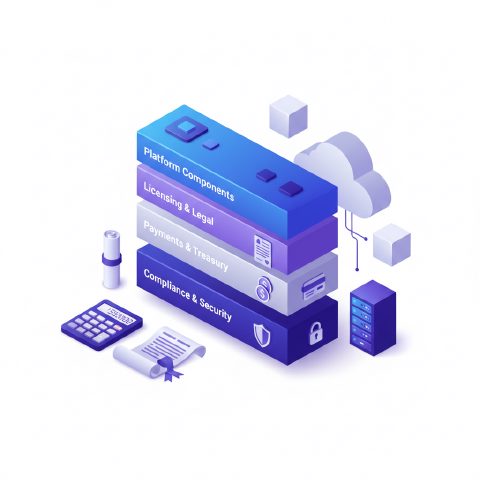
The total iGaming software price is a stack of at least seven distinct cost layers: platform license/revenue share, game aggregator fees, payment processing, KYC/AML tooling, responsible gambling modules, hosting/CDN infrastructure, and affiliate or CRM software. Most operators budget for two or three and get blindsided by the rest.
Platform fees are the obvious one. What operators routinely miss is that the game aggregator revenue share is a separate charge layered on top. If you're accessing 5,000+ titles through an aggregator like Relax Gaming, Pariplay or SoftSwiss Game Aggregator, expect to pay 3–8% of GGR on top of your platform share. Some white-label bundles include aggregator access in their headline rate — always ask explicitly whether game revenue share is included or additional, because the difference can be 10+ percentage points of GGR.
Payment processing is chronically underestimated. A standard card processing rate for iGaming sits at 3–6% per transaction — higher than most other verticals because acquiring banks price in chargeback risk. Add crypto payment gateway fees (0.5–2%), e-wallet fees (1–3%), and the cost of a payment orchestration layer if you're routing across multiple PSPs, and payment costs alone can represent 5–12% of gross revenue. Operators in LATAM or Southeast Asia often pay even more due to limited acquiring options and local payment method integration costs.
KYC and AML tooling is non-negotiable in any regulated jurisdiction. Providers like Sumsub, Onfido or Jumio charge per-verification — typically $1.50–$5.00 per identity check — plus a monthly platform fee. In a high-volume operation verifying thousands of players monthly, this line item alone can run $5,000–$20,000/month. Add a transaction monitoring tool (ComplyAdvantage, Acuris Risk Intelligence, etc.) and you're looking at another $1,000–$5,000/month depending on transaction volume. Operators who try to skip these tools in lightly regulated markets often find they need them anyway when payment processors demand AML evidence.
Responsible gambling modules — self-exclusion integrations, deposit limit engines, reality checks, player behavior monitoring — are mandatory under MGA, UKGC and all US state licenses. Vendors like Neccton (now part of Kindred's tech stack) or BetBlocker integrations carry their own licensing fees. Even under Curaçao, the 2023 framework overhaul pushed operators toward documenting responsible gambling procedures, which means software support. Budget $500–$3,000/month for this layer depending on the sophistication required by your license.
| Cost Component | Typical Monthly Range | Notes |
|---|---|---|
| Platform fee / revenue share | $5,000–$50,000+ | Scales with GGR; white-label typically 15–35% |
| Game aggregator share | $3,000–$30,000+ | 3–8% of GGR; sometimes bundled |
| Payment processing | 5–12% of gross revenue | Card + crypto + e-wallet blended rate |
| KYC / AML tooling | $1,500–$20,000 | Per-verification + monthly platform fee |
| Hosting / CDN / infrastructure | $500–$5,000 | Scales with traffic; Cloudflare, AWS, etc. |
| Responsible gambling modules | $500–$3,000 | Mandatory under MGA, UKGC, US states |
| Affiliate / CRM platform | $500–$3,000 | Income Access, MyAffiliates, Optimove, etc. |
| Fraud prevention | $500–$4,000 | Kount, SEON, Featurespace or similar |
How does jurisdiction change what you pay for casino software?
Jurisdiction is the multiplier nobody talks about in vendor pricing conversations. A Curaçao white-label might cost $30,000 to launch; the equivalent build for a New Jersey iGaming license or an MGA B2C license requires an additional $100,000–$300,000 in compliance-driven software, testing and certification before you go live.
Curaçao and Anjouan remain the cheapest regulatory environments from a software compliance standpoint. The technical requirements are minimal — basic RNG certification, some player protection disclosures — and most white-label providers already have their platforms certified, so you inherit compliance rather than building it. That's the trade-off: you're also inheriting a license that payment processors increasingly scrutinize, which drives up your acquiring costs and limits your banking options. The software is cheap; the payment stack is expensive.
MGA (Malta Gaming Authority) is the gold standard for EU operators and carries real software obligations. You need a certified RNG audit from an approved lab (BMM, GLI, eCOGRA), a responsible gambling system that meets MGA's Player Protection Directive, a documented AML framework with supporting software, and integration with the MGA's license management portal. The certification process alone — before you acquire a single player — typically costs $50,000–$120,000 in lab fees, legal fees and technical remediation. Ongoing compliance software runs another $3,000–$8,000/month.
US state licenses are the most demanding and most variable. New Jersey (DGE) and Pennsylvania (PGCB) require platform certification by a state-approved testing lab, geolocation verification (GeoComply is the de facto standard at roughly $0.01–$0.05 per session check), integration with state self-exclusion databases (NJ's NJSEP, PA's PGCB exclusion list), and in some cases dedicated server infrastructure within state boundaries. GeoComply alone can run $5,000–$30,000/month for an active US operation. Michigan, Connecticut and West Virginia have similar requirements with minor variations. Budget $200,000–$400,000 in technical compliance costs just to get a US state license live — and that's before your platform or game fees.
LATAM markets like Colombia (Coljuegos) and Peru (MINCETUR) sit in the middle. They have real compliance requirements — certified platforms, local payment integrations, Spanish-language responsible gambling tools — but the technical bar is lower than MGA or US states, and the local software ecosystem is growing. Mexico (SEGOB) remains murky; the licensing framework is old and enforcement is inconsistent, which paradoxically makes the compliance software cost hard to predict because operators hedge by over-investing in KYC to appease payment processors even when the regulator doesn't mandate it.
What hidden costs do operators discover after signing a platform contract?
The three most common post-signing surprises are: game launch fees charged per title above a base library, payment integration development costs billed hourly, and minimum guarantee clauses that mean you pay a floor fee even when GGR is low. A fourth — revenue share on bonuses — catches out operators who don't read the GGR definition in the contract.
Game library access sounds unlimited until you read the contract. Many white-label providers include 500–1,500 games in the base package and charge a per-game or per-provider activation fee for titles outside that bundle. Adding a popular live casino provider like Evolution Gaming or Pragmatic Play Live can carry a separate negotiated revenue share — often 1–3% of live casino GGR on top of your platform share. If live casino is central to your strategy, nail down these costs before signing. I've seen operators discover a $15,000/month live casino add-on they didn't budget for during a launch review call.
Payment integration is another trap. Most platforms advertise "200+ payment methods" but the reality is that 20–30 methods are pre-integrated and live. Adding a local payment method for your target market — a Brazilian PIX integration, a Colombian PSE connection, a Mexican SPEI gateway — often requires custom development work billed at $150–$300/hour. A single payment method integration can run $5,000–$20,000 depending on the provider's API quality. Always ask for a list of pre-integrated, live payment methods for your specific target geography — not the global headline number.
Minimum guarantee clauses are standard in platform contracts and almost never highlighted in sales conversations. A typical clause might state that you pay whichever is higher: the actual revenue share or a flat monthly minimum of $5,000–$15,000. In your first three to six months when GGR is low, you're paying the minimum regardless of performance. Over a 12-month ramp period, that can mean $60,000–$180,000 in platform fees before your operation is profitable. Model this explicitly in your cash flow projections — it's not a theoretical risk, it's a near-certainty for new operators.
GGR definition is the most technically boring and financially consequential clause in your contract. Some platforms define GGR as bets minus wins before bonuses; others deduct bonus costs. The difference is massive if you run aggressive welcome bonus campaigns. An operator running 100% match bonuses on deposits might see 40–60% of their apparent GGR wiped out by bonus costs — but if the platform calculates revenue share on pre-bonus GGR, you're paying full rate on money you effectively gave back to players. Push for a post-bonus GGR definition, or at minimum a bonus cost deduction cap.
How do game aggregator costs work and what should operators negotiate?
Game aggregator fees are typically 3–8% of GGR on aggregated content, charged on top of your platform fee. The exact rate depends on your volume, the aggregator, and whether you're accessing content through a white-label bundle or a direct aggregator deal. Direct studio deals are cheaper per title but require minimum guarantees most new operators can't meet.
The major aggregators — SoftSwiss Game Aggregator, Relax Gaming, Pariplay (Everi), Hub88 — price on a sliding scale. Small operators pay toward the top of the range; operators doing $1M+ GGR/month can negotiate meaningful discounts. The aggregator's pitch is access to 5,000–10,000 titles through one integration, which is genuinely valuable versus integrating each studio separately. But the blended revenue share on that library is real money. At 5% of $200,000 GGR/month, you're paying $10,000/month to the aggregator alone — $120,000/year for game access.
Direct studio deals — going straight to Pragmatic Play, NetEnt/Red Tiger (Light & Wonder), Play'n GO or Hacksaw Gaming — are cheaper in percentage terms, typically 2–4% of GGR for that studio's content. The catch: most studios require minimum monthly guarantees ($2,000–$10,000/month depending on the studio's tier) and a direct integration that takes 4–12 weeks of development per studio. For a new operator with 10 studios in their target portfolio, that's potentially $50,000–$120,000 in minimum guarantees before you've proven the market. Aggregators eliminate that risk in exchange for a higher blended rate — a trade-off that makes sense for most operators until they hit meaningful scale.
Negotiating aggregator deals: the two levers that actually move are volume commitments and exclusivity of certain content. If you can credibly commit to a GGR floor — say, $150,000/month within six months — some aggregators will discount the rate by 1–2 percentage points from day one. Alternatively, if you're launching in a geography the aggregator is actively trying to penetrate (Colombia, Brazil, specific US states), your launch can have strategic value to them beyond pure revenue, which creates negotiating room. Always ask for a rate review clause at 6 and 12 months tied to GGR milestones.
What does online casino software cost for a US-regulated market specifically?
A US state iGaming launch — New Jersey, Pennsylvania, Michigan — requires $300,000–$700,000 in software, compliance and infrastructure costs before going live, plus $100,000–$250,000/year in ongoing compliance software. This is not a market for undercapitalized operators. The software requirements alone exceed the entire launch budget of a typical offshore white-label.
The US market's cost structure is driven by state-level technical standards that have no equivalent in offshore licensing. Every state-approved gaming platform must be tested and certified by a state-approved independent testing laboratory — GLI (Gaming Laboratories International) and BMM Testlabs are the two dominant players. Certification fees vary by state and platform complexity but typically run $50,000–$150,000 for initial certification, with annual recertification costs of $20,000–$50,000. Any material platform update — a new bonus engine, a new payment method, a significant UI change — may trigger a re-certification requirement.
Geolocation is mandatory and GeoComply is effectively the only vendor that all US state regulators accept without question. GeoComply pricing is volume-based and not publicly disclosed, but operators report costs in the range of $0.01–$0.05 per session verification. At 50,000 active sessions/month, that's $500–$2,500/month at the low end — manageable. At 500,000 sessions/month for a competitive operator, you're looking at $5,000–$25,000/month just for geolocation. Operators launching in multiple states pay per-state licensing fees on top of the per-session charge.
State self-exclusion database integrations are technically straightforward but operationally critical. New Jersey's NJSEP, Pennsylvania's PGCB exclusion list, Michigan's MGCB list — each requires a real-time API integration with defined response time SLAs. The development cost is modest ($5,000–$15,000 per state), but the ongoing maintenance and the liability exposure for failures make this a non-trivial operational overhead. Some platform vendors include US state integrations in their enterprise packages; most charge separately.
The market access model adds another cost layer unique to the US. Most states require an iGaming operator license to be held by or affiliated with a land-based casino licensee (a "skin" or "market access" arrangement). Market access fees — paid to the land-based partner — range from $1M–$5M upfront plus 15–25% of iGaming revenue in some states, though structures vary significantly. This isn't strictly a software cost, but it's part of the total cost of entry that makes US iGaming a $5M+ minimum commitment for serious operators.
How should operators evaluate iGaming software vendors beyond the price?
Price is the wrong primary filter for platform selection. The right filters are: uptime SLA and track record, payment success rates in your target market, time-to-market for new features, and the quality of the back-office reporting. A cheap platform that converts 60% of deposits versus a pricier one that converts 85% is a false economy at any GGR level.
Uptime and performance are where cheap platforms kill operators silently. A platform with 99.5% uptime sounds fine until you calculate that 0.5% downtime is 43 hours/year — and iGaming downtime during peak hours (Friday and Saturday evenings) can cost a mid-size operator $50,000–$200,000 in lost GGR. Ask vendors for their actual uptime records, not their SLA target. Ask specifically about their worst outage in the past 12 months and how long it took to resolve. If they can't answer that question candidly, that tells you something.
Payment conversion rates are the most underrated platform metric. Two platforms can have identical game libraries and pricing, but if one achieves 80% payment success rates and the other achieves 65%, the difference in real revenue is enormous. Payment success depends on the platform's PSP relationships, their payment routing logic, and how well their checkout flow handles 3DS authentication, bank declines and alternative payment fallbacks. Ask for payment conversion data segmented by your target geography — aggregate numbers hide market-specific failures.
Back-office quality matters more than operators realize pre-launch. You'll live in the back-office every day: player management, bonus configuration, reporting, fraud review, payment reconciliation. Platforms with weak back-offices create operational overhead that costs real money in staff time and errors. Request a full back-office demo — not a sales demo of the flashy front-end — and specifically test: how do you manually adjust a player's balance? How do you configure a wagering requirement? How granular is the reporting by game, by payment method, by geography? The answers reveal whether the platform was built by people who've actually operated a casino.
What are realistic total first-year costs for launching an online casino?
A realistic first-year total — software, licensing, compliance, payments and basic operations — runs $150,000–$400,000 for an offshore white-label launch and $600,000–$2M+ for a regulated EU or US market entry. These figures exclude player acquisition costs, which typically exceed the software stack by 2–5x in a competitive market.
For an offshore white-label launch (Curaçao or Anjouan license, targeting tier-2 or tier-3 markets), the cost breakdown looks roughly like this: platform setup $20,000–$40,000, license acquisition $15,000–$30,000, game aggregator setup $5,000–$10,000, payment integrations $10,000–$25,000, KYC/AML tooling setup $5,000–$10,000, website design and localization $10,000–$30,000, and first-year ongoing fees (platform revenue share, game share, hosting, compliance tools) $60,000–$200,000 depending on GGR. Total first-year: $125,000–$345,000. That's a real budget, not a vendor's optimistic slide.
For an MGA-licensed operation targeting Western Europe, add: MGA license application fee (€25,000), technical audit and RNG certification ($50,000–$100,000), responsible gambling software ($15,000–$40,000/year), enhanced KYC/AML stack ($30,000–$80,000/year), and the higher operational overhead of a properly staffed compliance function. Total first-year for an MGA launch: $400,000–$900,000 before marketing. This is why many operators start offshore and migrate to MGA once they've proven the model — the compliance cost is real and front-loaded.
Marketing and player acquisition are conspicuously absent from most software cost discussions, but they dwarf the software stack in competitive markets. A realistic customer acquisition cost (CAC) in a competitive European market runs $200–$600 per depositing player. To build a base of 1,000 active depositing players, you're spending $200,000–$600,000 in acquisition alone. Factor in the typical 6–12 month payback period on a casino player and you need significant working capital reserves beyond your software and licensing budget. Any business plan that doesn't model player acquisition separately from software cost is incomplete.
Can you reduce iGaming software costs without sacrificing quality?
Yes, but the levers are specific. Revenue share negotiation at contract renewal, aggregator consolidation, payment stack optimization and timing your platform upgrade cycles correctly can collectively reduce software costs by 15–30% without touching product quality. The savings are real but require operator-side sophistication to capture.
Revenue share negotiation is the highest-leverage cost reduction available to an established operator. Most platform contracts include a rate review clause at 12 or 24 months, and most vendors have 3–5 percentage points of GGR flexibility they don't volunteer. The negotiating position is simple: present your GGR trajectory, your payment conversion data (showing you're a quality operator), and a competing quote from another platform. You don't need to actually switch — you need a credible alternative. Operators who've reduced their platform share from 20% to 14% by doing this math correctly have freed up $72,000/year on $100,000 GGR/month. That's real money.
Aggregator consolidation reduces complexity and improves negotiating leverage. Operators running three separate aggregator deals often pay more in blended revenue share than operators who've consolidated to one primary aggregator with volume commitments. The trade-off is some title exclusivity and flexibility, but for most operators the financial benefit of a consolidated deal outweighs the marginal value of a few hundred additional titles. Audit your actual game play data — in most casinos, 80% of GGR comes from 100–200 titles. You probably don't need 8,000 games.
Payment stack optimization is a slow burn that compounds significantly. Improving payment success rates by 5–10 percentage points through better PSP routing, 3DS optimization and local payment method coverage directly increases GGR without changing the software cost base. Providers like Nuvei, Checkout.com and Worldpay have iGaming-specific optimization teams — use them. Similarly, auditing your KYC tooling annually often reveals you're paying for verification volume tiers you've outgrown in the wrong direction (paying for 10,000 verifications/month when you're only doing 2,000). Right-sizing these contracts saves $1,000–$5,000/month for a mid-size operator.



Comments
No comments yet, be the first.