White Label Crypto Casino Cost Breakdown: What Operators Actually Pay in 2026
What does a white label crypto casino actually cost to launch?
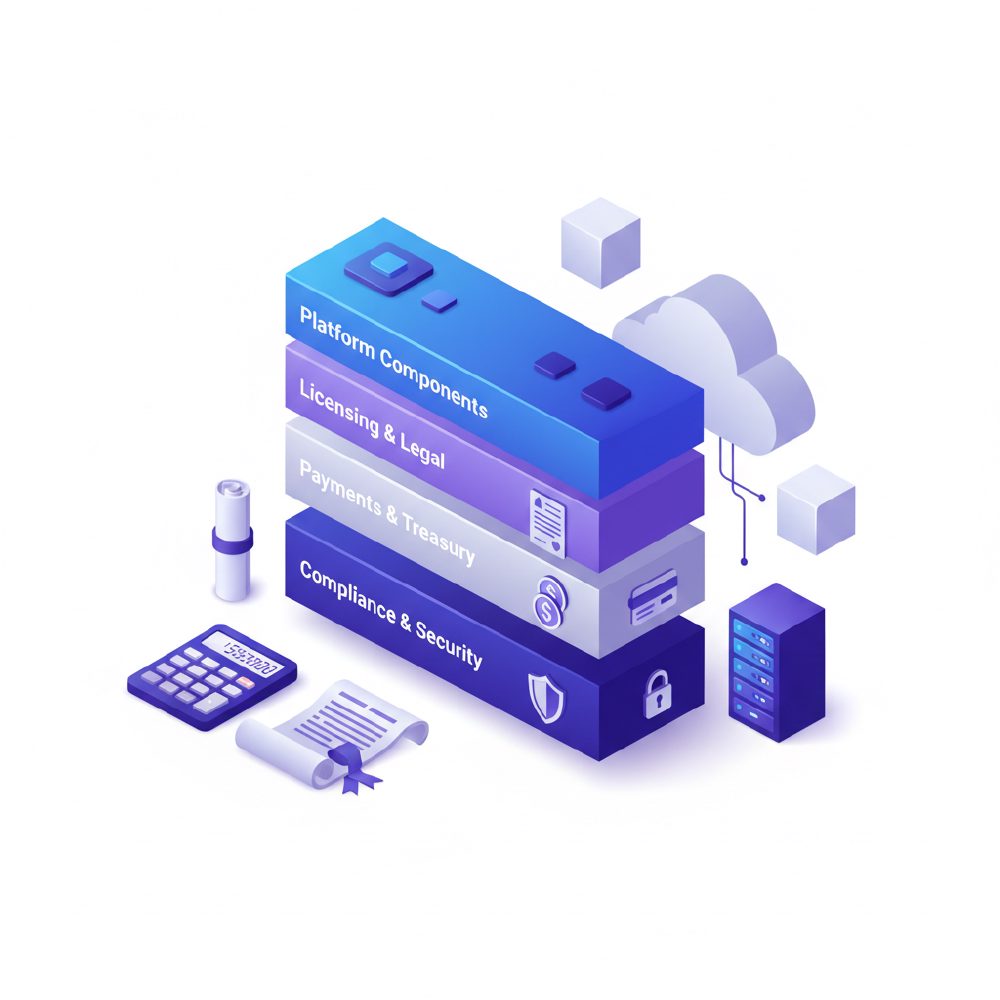
A realistic white label crypto casino launch budget in 2026 sits between $30,000 and $120,000 all-in for the first six months, covering platform setup, licensing, a crypto payment layer, and basic marketing. The wide range reflects jurisdiction choice, game library size, and whether you negotiate a flat monthly fee or a revenue-share arrangement with your provider.
The number vendors quote on a discovery call is almost always the platform setup fee in isolation. That figure typically runs $10,000 to $30,000 for an established white-label provider like SoftSwiss, EveryMatrix, or Digitain. It sounds manageable. What it excludes is the licensing fee, the crypto wallet integration, the KYC/AML stack, the ongoing revenue share, the content aggregator margin baked into your game feed, and the customer support tooling you will need from day one.
Break it down by category and the picture gets clearer. Licensing under the new Curaçao Gaming Authority framework (post-2023 reform) costs roughly $15,000-$25,000 in government fees plus $5,000-$15,000 in legal and compliance setup, depending on the law firm you use. An Anjouan license through the Anjouan Online Gambling Authority runs cheaper, around $10,000-$20,000 total, but carries less credibility with payment processors. Neither number includes the annual renewal or the ongoing compliance reporting costs.
Crypto payment integration through a provider like CoinsPaid or Utorg adds a one-time integration fee of roughly $1,000-$5,000 and a per-transaction fee typically in the 0.4-1.0% range. That sounds trivial until your monthly crypto volume hits $500,000 and you realize you are paying $2,000-$5,000 per month just in processing. NOWPayments operates on a similar model and is popular with smaller operators because it has no monthly minimum, but its settlement options are narrower.
The honest six-month total for a lean but credible crypto casino launch, using a mid-tier white-label platform, Curaçao licensing, and a single crypto payment provider, is around $60,000-$90,000 before any paid acquisition spend. Budget $100,000-$150,000 if you want a fiat hybrid stack or a broader game library from launch day.
How does white label differ from turnkey for a crypto casino?
White label means you rent the platform infrastructure and brand it yourself, paying ongoing revenue share or monthly fees to the provider. Turnkey means you buy or license the full software stack outright, giving you more control and no perpetual revenue share, but requiring a larger upfront capital commitment and in-house technical capacity to operate it.
The distinction matters enormously for a crypto casino because crypto margins are often thinner than fiat margins. A revenue-share clause at 20-30% of GGR on a white-label arrangement can quietly consume more profit than the entire tech stack is worth once your operation reaches meaningful volume. Most white-label providers set their revenue share on gross gaming revenue after bonuses but before payment costs, so the effective take on net revenue is higher than the headline percentage suggests.
Turnkey crypto casino platforms from providers like Slotegrator or GamMatrix let you pay a larger upfront license fee (typically $50,000-$200,000 depending on the feature set) and then operate with only a small maintenance fee or no ongoing royalty. The catch is that you are responsible for your own hosting, security patching, game content updates, and payment integrations. That requires at least one technical hire or a retained development agency, adding $3,000-$8,000 per month in operational overhead.
For operators launching with under $150,000 in total capital, white label is almost always the right starting point. The platform provider handles uptime, security, game certification, and payment plumbing. You focus on acquisition and retention. The revenue-share cost is real, but it is a variable cost that scales with revenue, which is preferable to a fixed technical overhead when you are still proving the market. The time to reconsider is when your monthly GGR consistently exceeds $200,000 and the revenue-share payment exceeds what a turnkey license plus in-house ops would cost.
| Factor | White Label | Turnkey |
|---|---|---|
| Upfront cost | $10,000-$30,000 setup | $50,000-$200,000 license |
| Ongoing cost | 15-35% GGR rev-share + monthly fee | Maintenance fee only ($500-$3,000/mo) |
| Time to launch | 4-10 weeks | 3-6 months |
| Technical ownership | Provider manages platform | Operator owns/operates stack |
| Customization | Limited (skin/branding level) | Full (code-level access) |
| Scalability cost | Rev-share grows with revenue | Fixed cost, higher margin at scale |
| Best for | First-time operators, under $150K budget | Experienced teams, $200K+ monthly GGR |
Which licensing jurisdictions work best for crypto casino white labels in 2026?
Curaçao and Anjouan are the two practical offshore licensing routes for crypto-focused white-label casinos in 2026. Curaçao's reformed framework under the new National Ordinance on Offshore Games of Hazard (NOOGH) is more credible with payment processors but costs more. Anjouan is faster and cheaper but accepted by fewer banking partners.
Curaçao went through a significant regulatory overhaul starting in 2023. The old master license / sub-license model, where operators piggybacked on a master licensee like Antillephone or Cyberluck, was phased out. By 2024, operators needed their own direct license from the Curaçao Gaming Authority. Government fees for a new license are in the range of $15,000-$25,000, with annual renewals around $10,000-$15,000. The compliance requirements, including AML policies, responsible gambling measures, and technical standards, are materially stricter than the old sub-license regime. That is not a bad thing. It makes the license more defensible with crypto payment providers and banking partners who previously refused Curaçao-licensed operators.
Anjouan (the Anjouan Online Gambling Authority, operating under the Comoros Islands framework) emerged as a lower-cost alternative around 2022-2023. Total licensing cost is roughly $10,000-$20,000 with faster issuance, sometimes under six weeks. The trade-off is that Anjouan's regulatory credibility is lower, and several crypto payment processors apply additional due diligence to Anjouan-licensed operators. If you are targeting markets where players are sophisticated about licensing, Anjouan may hurt conversion at the KYC stage.
Malta Gaming Authority (MGA) and UK Gambling Commission licenses are off the table for most white-label crypto casino operators because both regulators have restrictions or outright prohibitions on anonymous crypto play, and the compliance cost for an MGA license runs $25,000-$50,000 in fees plus significant ongoing compliance overhead. They are worth pursuing only if you are targeting regulated EU markets with a fiat-plus-crypto hybrid model and have the capital to support a proper compliance function. For a pure crypto white label, stick with Curaçao or Anjouan and invest the saved compliance budget into better player acquisition.
| Jurisdiction | Approx. Setup Cost | Annual Renewal | Time to Issue | Crypto Acceptance | Payment Processor Acceptance |
|---|---|---|---|---|---|
| Curaçao (direct license) | $15,000-$25,000 | $10,000-$15,000 | 8-14 weeks | Permitted with AML controls | Good (improving post-reform) |
| Anjouan (AOGA) | $10,000-$20,000 | $5,000-$10,000 | 4-8 weeks | Permitted | Moderate (extra DD common) |
| Malta (MGA) | $25,000-$50,000+ | $25,000+ | 4-6 months | Restricted/hybrid only | Excellent |
| Isle of Man (GSC) | $20,000-$40,000 | $15,000-$25,000 | 3-5 months | Permitted with conditions | Good |
What are the ongoing monthly operating costs after launch?
After launch, a white label crypto casino typically costs $8,000-$25,000 per month in fixed and semi-fixed operating expenses before marketing. That range covers platform fees, licensing compliance, crypto payment processing, KYC/AML tooling, customer support, and basic hosting. Marketing is on top and is almost always the largest line item by month three.
The platform monthly fee is usually the most predictable cost. White-label providers like SoftSwiss charge a monthly platform fee (often $2,000-$5,000 for a standard package) plus the revenue-share percentage on top. EveryMatrix operates on a similar model. Some smaller providers offer a flat monthly fee with no revenue share, which can look attractive at low volumes but often comes with a smaller game library or fewer payment integrations. Always model both structures at your projected GGR to find the crossover point.
KYC and AML compliance tooling is a cost many first-time crypto casino operators underestimate. Even if your jurisdiction does not mandate KYC for crypto deposits under a certain threshold, your payment processor almost certainly will. Providers like Sumsub, Veriff, or Shufti Pro charge on a per-verification basis, typically $1.00-$2.50 per check, plus a monthly platform fee of $300-$1,000. At 500 new registrations per month with a 60% verification rate, that is $300-$750 per month in verification costs alone, before the platform fee. Fraud scoring tools like Seon or Kount add another $200-$800 per month depending on volume.
Customer support is another recurring cost that gets underestimated. A white-label provider may include a basic back-office and ticketing system, but they do not staff your support queue. Outsourced casino support through a specialist BPO runs $8-$15 per agent hour. A lean team covering live chat 16 hours per day in two languages costs roughly $3,000-$6,000 per month. That is non-negotiable if you want to retain players and pass any responsible gambling audit your licensing body might conduct.
Hosting and CDN costs are typically absorbed by the white-label provider at the base tier but can become a separate line item at higher traffic volumes. Budget $500-$2,000 per month for any custom infrastructure you add outside the platform provider's stack, such as a dedicated affiliate tracking system (Post Affiliate Pro, Income Access, or MyAffiliates run $200-$600 per month) or a separate CRM layer.
How does crypto payment integration affect the overall cost structure?
Crypto payment integration is cheaper to set up than a fiat PSP stack, but the per-transaction fees, wallet custody costs, and volatility management tools add up to a meaningful monthly line item. Expect to spend $1,500-$5,000 per month on crypto payment infrastructure once your operation is live and processing real volume.
Most white-label platforms have pre-built integrations with the major crypto payment processors, so you are not paying a custom development fee to connect CoinsPaid or Utorg. The integration cost is typically a one-time activation fee of $1,000-$3,000 plus a per-transaction percentage. CoinsPaid, which processes for a large share of the iGaming crypto volume, charges approximately 0.4-1.0% per transaction depending on volume tier. Utorg operates on a similar model and is particularly popular with operators targeting Eastern European and CIS markets because of its broader altcoin support.
Wallet custody is a cost layer that gets overlooked. When players deposit crypto, the funds sit in a hot wallet managed by your payment provider until settlement. Some providers settle daily; others settle weekly. During that window, you carry volatility risk on the unsettled balance. Most operators hedge this by converting to stablecoin (USDT or USDC) immediately on receipt, which adds a small conversion fee (typically 0.1-0.3%) but eliminates the price risk. If you are running a large BTC or ETH balance without hedging, a 10% price move in the wrong direction can wipe out a week of GGR.
For operators who want to accept both crypto and fiat, the payment stack gets materially more expensive. Adding a fiat PSP to a crypto-primary white-label casino requires a separate merchant account application, which is difficult for offshore-licensed operators. Providers like Paydoo, Interkassa, or Praxis Cashier specialize in iGaming payment aggregation and can bundle multiple acquirers under one integration, but their monthly fees start around $500 and their per-transaction rates are higher than standard e-commerce rates, often 3-6% on card payments. The compliance overhead for fiat acceptance is also higher because you need full PCI-DSS compliance and more robust AML procedures.
What game content costs should operators budget for?
On a white-label platform, game content is almost never free. The platform provider either takes a margin on the game aggregator feed (typically 10-20% of the game revenue they pass through) or charges a separate content fee. Operators who do not read this clause carefully end up paying more for game content than for the platform itself.
The mechanics work like this: your white-label provider integrates with a game aggregator like Softswiss Game Aggregator, Relax Gaming, or EveryMatrix's CasinoEngine. The aggregator takes a revenue-share cut from each game studio (typically 15-25% of GGR from that game). The platform provider may take an additional margin on top before passing the remaining revenue to you. If the game studio takes 15% and the aggregator takes 10% and your platform provider takes another 5%, you are retaining 70 cents of every dollar of game GGR before your own platform revenue-share kicks in. That math compounds quickly at scale.
The alternative is going direct to game studios for a sub-license. Studios like Pragmatic Play, Play'n GO, and Evolution Gaming do offer direct deals, but they come with minimum monthly guarantees (often $2,000-$10,000 per studio per month) and technical integration requirements. For a new operator, direct studio deals rarely make economic sense until you are generating enough volume to cover the guarantees comfortably. The aggregator model, despite its margin cost, gives you access to 3,000+ games from day one without individual studio negotiations.
Live casino content deserves a separate note. Evolution Gaming dominates live dealer supply and does not license through most aggregators on standard terms. Getting Evolution on your platform typically requires a direct deal with a minimum revenue commitment that is not publicly disclosed but is rumored to start around $5,000-$10,000 per month in guaranteed fees for new operators. Pragmatic Play Live and Ezugi (an Evolution subsidiary) are more accessible alternatives with lower entry minimums. For a crypto casino targeting a value-conscious player segment, Pragmatic Play Live is often the practical starting point.
What hidden costs do operators discover too late?
The costs that blindside operators are rarely the platform fee. They are the sub-licensee restrictions buried in the contract, the game margin the provider does not advertise, the compliance costs that spike at renewal, and the revenue-share escalator clause that activates once you hit a volume threshold you did not think you would reach in year one.
Revenue-share escalator clauses are the most common contract trap. A provider might offer 20% GGR share up to $100,000 monthly GGR, then 25% from $100,000 to $300,000, then 30% above that. On a slide deck this looks like a tiered incentive. In practice, it means your fastest-growing months generate the lowest net margin. Some providers structure this in reverse (lower percentage at higher volume, as a genuine volume discount), so read the clause carefully before signing and model all three tiers at realistic growth projections.
Sub-licensee restrictions are another underestimated cost. Some white-label providers operate on a master license from Curaçao or Anjouan and sub-license that to you. The sub-license often restricts which markets you can target, which payment methods you can use, and which game studios you can access. Worse, if the master licensee loses their license or exits the market, your operation is exposed. The move to direct licensing in Curaçao post-2023 was partly driven by operators who got burned by master licensee failures. Always verify whether you are getting a direct license or a sub-license, and what happens to your operation if the master licensee relationship ends.
Compliance costs at renewal are frequently higher than at initial setup. Curaçao's reformed framework now requires annual compliance audits by an approved testing laboratory, updated AML risk assessments, and technical certification for any new game content added during the year. Budget $5,000-$15,000 for annual compliance maintenance costs on top of the license renewal fee. Operators who budget only the renewal fee and skip the compliance audit are taking a license suspension risk that is not worth the saving.
Chargeback and fraud reserves are a cash-flow cost that crypto-primary operators sometimes avoid (crypto transactions are irreversible) but fiat-hybrid operators definitely face. Payment processors typically hold 5-10% of card processing volume in a rolling reserve for 90-180 days. On $200,000 per month in card volume, that is $10,000-$20,000 in locked capital at any given time. Factor this into your working capital model before you add fiat payment methods.
How long does it take to launch a white label crypto casino from contract to live?
A realistic timeline from signing a white-label contract to going live is 8-16 weeks, assuming you have your licensing application submitted in parallel. The platform setup itself takes 4-6 weeks. Licensing adds 6-14 weeks depending on jurisdiction. The critical path is almost always the license, not the platform build.
The platform setup timeline with an established provider like SoftSwiss or EveryMatrix is well-documented. After contract signing, the provider configures your instance, applies your branding, activates your game library, and connects your payment methods. For a standard white-label package with no custom features, this takes 4-6 weeks. Custom design work, additional payment integrations, or bespoke bonus engine configurations can push this to 8-10 weeks. The provider's project manager will give you a milestone list; the delays almost always come from the operator side, specifically slow brand asset delivery, delayed KYC document submission for the license, or indecision on game library configuration.
Licensing runs in parallel but typically takes longer. Anjouan can issue in 4-8 weeks if your application is complete and your corporate structure is clean. Curaçao's reformed process runs 8-14 weeks from submission to license issuance, and that assumes no requests for additional information from the regulator. Legal fees for preparing the application, drafting the AML policy, and setting up the required corporate structure (often a BVI or Curaçao entity) add 2-4 weeks of prep time before you even submit. Start the licensing process the same week you sign the platform contract, not after.
The go-live checklist that operators underestimate includes: responsible gambling tool configuration (mandatory for Curaçao), geolocation blocking for restricted jurisdictions, terms and conditions review by a gaming lawyer, and a pre-launch penetration test if your provider requires it. None of these are technically complex, but each one takes calendar time. An operator who treats these as post-launch tasks will find themselves holding a live platform with a license they cannot legally use yet.
What is a realistic ROI timeline for a white label crypto casino?
Most white-label crypto casinos that are properly capitalized and marketed reach operational break-even within 6-12 months. Genuine profitability after recouping the full launch investment typically takes 12-24 months. Operators who undercapitalize the marketing budget relative to the platform investment almost never reach break-even within the first year.
The single biggest mistake I see in operator business plans is a $60,000 platform and licensing budget paired with a $10,000 marketing budget for the first six months. The platform is not the product that generates revenue. Players are. A white-label crypto casino with excellent platform infrastructure and no player acquisition budget is a very expensive piece of software with no one using it. The marketing budget for the first six months should be at least equal to the platform and licensing budget, and ideally 1.5-2x that figure.
Affiliate marketing is the dominant acquisition channel for crypto casinos, and the cost structure is predictable. Affiliate networks like Income Access, MyAffiliates, or direct deals with crypto gambling affiliates typically operate on a revenue-share model of 25-40% of referred player GGR, or a CPA (cost per acquisition) of $100-$300 per depositing player. At a 30% affiliate revenue share and a 25% platform revenue share, you are retaining 45 cents of every dollar of GGR from affiliate-referred players. That is still a viable model, but it requires volume to generate meaningful absolute profit.
The operators who reach break-even fastest are those who enter with a clearly defined player segment (for example, high-stakes crypto poker players, or casual slots players in a specific language market), build their acquisition around that segment, and resist the temptation to add fiat payments, sportsbook, or live casino in the first six months. Each product extension adds cost and operational complexity before you have proven the core casino vertical. Launch lean, prove the model, then expand.
How do white label crypto casino costs compare across major platform providers?
Provider pricing varies significantly across the market. SoftSwiss and EveryMatrix sit at the premium end with higher setup fees but better game libraries and payment coverage. Mid-tier providers like Slotegrator or Digitain offer lower entry costs with narrower feature sets. The cheapest providers often impose the highest revenue-share percentages, which inverts the apparent cost advantage at any meaningful volume.
SoftSwiss (now operating as SOFTSWISS) is one of the most widely deployed white-label platforms for crypto casinos. Their setup fee is not publicly listed but is generally reported by operators in the $15,000-$30,000 range for a standard package. The platform includes their own Softswiss Game Aggregator with 10,000+ games, a crypto-native payment layer, and a back-office with reasonable bonus engine flexibility. Their revenue-share percentage is negotiable and typically falls in the 15-25% range depending on projected volume. For a crypto-primary operation, SOFTSWISS is a defensible first choice, though their contract terms around exclusivity and market restrictions deserve careful legal review.
EveryMatrix operates a modular platform (CasinoEngine for games, MoneyMatrix for payments, OddsMatrix for sports) that allows operators to pick components rather than buying a full bundle. This modularity is useful for operators who want to bolt a sportsbook onto a crypto casino later. Their pricing is similarly not public but is reported to be in a comparable range to SOFTSWISS for the full suite. Their MoneyMatrix payment layer has particularly strong fiat coverage, which matters if you plan a fiat-plus-crypto hybrid.
Slotegrator and Digitain are popular with operators entering the market with tighter budgets. Setup fees in the $5,000-$15,000 range are common, and some packages are offered on a pure revenue-share basis with no upfront fee. The trade-off is a smaller game library, less mature back-office tooling, and in some cases a less robust payment integration layer. For a crypto-only operation targeting a single language market, these providers can be a cost-effective starting point. For an operator planning multi-currency, multi-language operations from launch, the premium providers justify their higher entry cost.
| Provider | Setup Fee (Est.) | Revenue Share | Game Library | Crypto-Native | Best For |
|---|---|---|---|---|---|
| SOFTSWISS | $15,000-$30,000 | 15-25% GGR | 10,000+ games | Yes (built-in) | Crypto-primary, mid-large operators |
| EveryMatrix | $15,000-$35,000 | 15-25% GGR | 12,000+ games | Via MoneyMatrix | Hybrid fiat/crypto, modular builds |
| Slotegrator | $5,000-$15,000 | 20-35% GGR | 6,000+ games | Partial | Budget-conscious first launches |
| Digitain | $8,000-$20,000 | 20-30% GGR | 7,000+ games | Partial | Sports + casino combo launches |
| GamMatrix (Softswiss alt) | $10,000-$25,000 | 18-28% GGR | 8,000+ games | Yes | Operators wanting more contract flexibility |
What should operators include in their total budget before approaching a white label provider?
Before signing anything, an operator needs a fully loaded budget that covers platform setup, licensing, legal, payment integration, compliance tooling, customer support, and six months of marketing. The minimum credible budget for a crypto-primary white label launch in 2026 is $80,000. Anything below that and you are cutting corners that will cost more to fix later.
Here is how a realistic $100,000 launch budget breaks down across categories. Platform setup and first-year platform fees: $20,000-$35,000. Licensing (Curaçao direct or Anjouan, including legal fees): $20,000-$35,000. Crypto payment integration and first-year processing infrastructure: $5,000-$10,000. KYC/AML tooling (Sumsub or equivalent, six months): $3,000-$6,000. Customer support (outsourced BPO, six months): $15,000-$25,000. Marketing and affiliate seed budget (six months): $20,000-$40,000. Working capital buffer for unexpected compliance costs, chargebacks, or contract renegotiation: $10,000-$20,000. These ranges overlap because the exact split depends on your market focus and whether you negotiate a lower setup fee in exchange for a higher revenue share.
The working capital buffer is not optional. Every operator I have advised has hit at least one unexpected cost in the first six months: a licensing delay that requires a legal escalation fee, a payment processor that freezes settlement pending additional documentation, or a game studio that requires a minimum guarantee renegotiation. Having $10,000-$20,000 in reserve that is not earmarked for anything specific is the difference between a fixable problem and a crisis.
One final point on budget allocation: do not let a vendor talk you into spending more on platform customization in the first six months. Custom design work, bespoke bonus mechanics, and proprietary features are expensive and slow. The operators who launch fastest and prove their model quickest are those who accept the standard white-label template, configure it well, and redirect the customization budget into player acquisition. You can invest in differentiation once you know which player segments are converting for you. Spending $15,000 on a custom UI before you have a single depositing player is a bet on aesthetics, not on business fundamentals.




Comments
No comments yet, be the first.