How to Start an Online Casino in the US in 2026: 7 Licensed States vs. 39 That Will Get You Arrested
Which US states have legal online casinos in 2026?
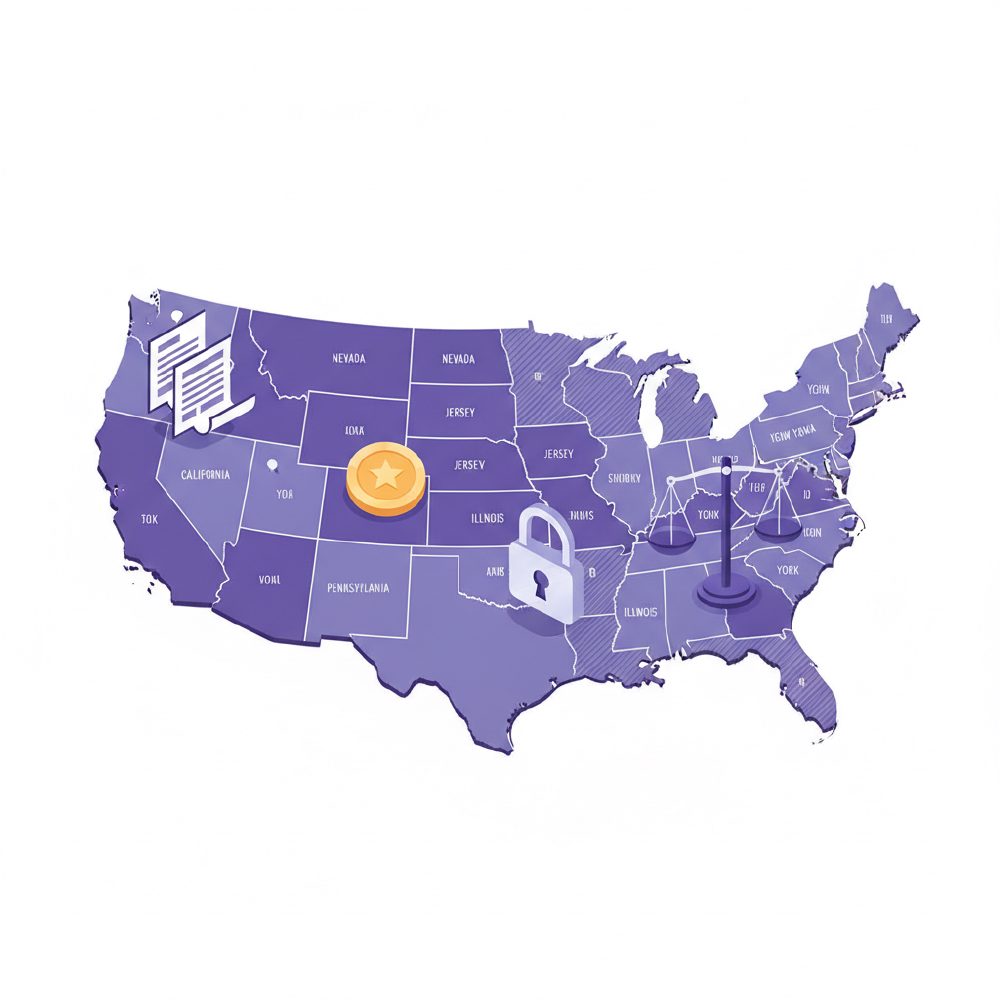
Seven states have active, licensed real-money online casino frameworks in 2026: New Jersey, Pennsylvania, Michigan, Delaware, West Virginia, Connecticut and Rhode Island. Every other state either lacks enabling legislation, has explicitly banned iGaming, or permits only sports betting. If you are not operating under one of these seven state licenses, you are operating illegally under US federal and state law.
New Jersey remains the largest and most mature market, having launched in 2013 under the Division of Gaming Enforcement (DGE). Pennsylvania followed in 2019 under the Pennsylvania Gaming Control Board (PGCB) and has since overtaken New Jersey in gross gaming revenue in several quarters. Michigan launched in January 2021 under the Michigan Gaming Control Board (MGCB) and has grown rapidly, partly because it includes tribal operators under a separate but parallel framework. Delaware was technically first in 2012 but its market is tiny, three state lottery-operated skins, and offers almost no commercial opportunity for new entrants.
West Virginia passed its iGaming law in 2019 (West Virginia Lottery Interactive Wagering Act) but actual player launches were delayed; the market remains small with a handful of active skins. Connecticut launched in October 2021, operated exclusively through the Mashantucket Pequot and Mohegan tribal nations alongside the state lottery, there is no path for an independent commercial operator to enter Connecticut without a tribal partnership. Rhode Island is the newest addition, with legislation signed in 2023 and live operations beginning in 2024 under the Rhode Island Lottery, again a state-controlled model with limited commercial entry points.
The practical takeaway: of the seven, New Jersey, Pennsylvania and Michigan offer the most realistic commercial opportunity for a new operator. The other four are either structurally closed to independent operators or too small to justify the compliance overhead. If you are modeling revenue projections, use NJ, PA and MI as your primary addressable markets and treat the others as optionality.
| State | Launch Year | Regulator | Commercial Entry Path | Market Size (Est. Annual GGR) |
|---|---|---|---|---|
| New Jersey | 2013 | DGE | Licensed land-based partner required | ~$2B+ |
| Pennsylvania | 2019 | PGCB | Licensed land-based partner required | ~$2B+ |
| Michigan | 2021 | MGCB | Commercial or tribal partner required | ~$1.5B+ |
| Delaware | 2012 | Delaware Lottery | State lottery model, closed to independents | <$100M |
| West Virginia | 2019 | WV Lottery | Licensed land-based partner required | <$200M |
| Connecticut | 2021 | CTHC / Tribal compacts | Tribal partnership only | <$300M |
| Rhode Island | 2024 | RI Lottery | State lottery model, closed to independents | <$100M |
Why are 39 states still off-limits for online casino operators?
The remaining 43 states (minus the 7 above, minus a handful with pending bills) either have no enabling legislation, have actively prohibited iGaming in their statutes, or permit only sports betting under post-PASPA frameworks. Federal law, specifically the Wire Act and UIGEA, does not legalize iGaming nationally; it falls entirely to individual states, and most have not moved.
The Wire Act of 1961 and the Unlawful Internet Gambling Enforcement Act (UIGEA) of 2006 form the federal floor. UIGEA does not make online gambling explicitly illegal for players, but it prohibits payment processing for unlicensed gambling, which effectively makes operating a real-money casino site targeting US players without state authorization a federal crime. A 2011 DOJ opinion clarified that the Wire Act applies only to sports betting, opening the door for states to legalize other forms of online gambling. But that opinion was revisited in 2018 and again litigated through 2021; the legal landscape remained favorable to state-level iGaming, but the uncertainty slowed legislative momentum.
Many states have sports betting but not iGaming. New York is the clearest example: it has one of the largest legal sports betting markets in the world (over $20B in handle annually), but online casino legislation has stalled repeatedly in Albany despite strong lobbying from operators including DraftKings, FanDuel and BetMGM. The political opposition typically comes from a combination of land-based casino interests protecting their floor revenue and legislators worried about problem gambling optics. Illinois, Indiana, and Massachusetts are in similar positions, sports betting is live, iGaming is not.
A handful of states have explicit prohibitions written into their statutes or constitutions. Utah and Hawaii have the broadest anti-gambling laws in the country and are realistically never going to legalize online casinos. Other states like Idaho and Tennessee have narrow carve-outs for lottery and sports betting respectively but no pathway for casino-style games. If you are building a US market entry strategy, do not waste legal budget trying to find workarounds in these states, there are none that do not carry criminal exposure.
How do you actually start an online casino in a licensed US state?
You cannot simply apply for a standalone online casino license in any US state. Every regulated state requires you to operate as a 'skin' or interactive gaming operator tied to an existing licensed land-based casino entity. That means your first step is not a license application, it is securing a commercial partnership with a licensed brick-and-mortar operator, which typically involves revenue share, equity, or a management agreement.
The structural model in NJ, PA and MI works like this: a land-based licensee (the 'permit holder') can offer up to a fixed number of online skins under their license. In New Jersey, each Atlantic City casino can support multiple skins. In Pennsylvania, each licensed casino can offer one interactive gaming certificate per game category. The skin operator (you) applies for an Interactive Gaming Operator license or Certificate, but the application is contingent on your partnership agreement with the permit holder. Without that agreement, your application goes nowhere.
Finding and negotiating that partnership is the hardest part of a US market entry and the step most offshore-experienced operators underestimate. Land-based casinos in these states receive multiple approaches from would-be skin operators every month. They are looking for operators who bring differentiated player acquisition capabilities, a credible technology stack, and a realistic revenue projection, not just a licensing fee. Expect revenue share negotiations to land somewhere between 20-35% of GGR going to the land-based partner, though this varies considerably based on the partner's leverage and your deal structure.
Once the partnership is in place, the license application itself is exhaustive. Pennsylvania's PGCB requires personal disclosure forms for all principals with more than 1% ownership, financial background checks going back 10 years, a detailed business plan, source-of-funds documentation, and technical compliance certification of your platform. The PGCB's Interactive Gaming Certificate application fee alone is $10 million for a full certificate (covering slots, table games and poker). New Jersey's fees are lower, around $400K for an initial license, but the DGE's suitability review is equally rigorous. Michigan sits in between, with initial licensing fees in the $100K-$200K range depending on operator type.
Platform technology must be independently tested and certified by a state-approved testing laboratory, GLI (Gaming Laboratories International) and BMM Testlabs are the two most commonly used in US regulated states. This is not a rubber stamp. Certification covers RNG integrity, game math, responsible gambling tools, geolocation enforcement (GeoComply is effectively mandatory), and AML/KYC integration. Budget 3-6 months for this process and do not start it until your platform is genuinely production-ready.
What does it actually cost to launch in a regulated US state?
Realistic all-in costs to launch a licensed online casino skin in New Jersey or Pennsylvania range from $1.5M to $5M+ before you reach profitability, depending on your technology choices, the terms of your land-based partnership, and your player acquisition budget. The licensing fee is the smallest line item. Legal, compliance and platform integration will cost more than the fee itself.
Here is a realistic cost breakdown for a PA launch, which is the most common entry point for new operators given the market size and the availability of willing land-based partners. Application and licensing fees: $10M for a full Interactive Gaming Certificate is the statutory amount, though operators can apply for a limited certificate (slots only or table games only) for lower fees, check current PGCB schedules as these have been revised. Legal and compliance: $300K-$800K for outside counsel familiar with PGCB process, plus ongoing compliance staffing. Platform and technology: $200K-$600K for integration, certification and first-year licensing of a compliant platform stack. Geolocation (GeoComply): ~$0.10-$0.30 per session, which adds up quickly at scale. Marketing and player acquisition: this is where operators consistently underfund, a realistic first-year PA marketing budget for a new skin is $2M-$5M just to get to meaningful player volumes against entrenched competitors like BetMGM, DraftKings and Caesars.
New Jersey is cheaper to enter from a licensing fee perspective but the market is more mature and acquisition costs are higher. Michigan is attractive because the tribal gaming framework creates some differentiated partnership opportunities and the market is still growing. West Virginia and Connecticut are technically accessible but the addressable player population is small enough that unit economics are challenging for a standalone skin without cross-state synergies.
One cost that surprises operators coming from offshore markets: responsible gambling infrastructure is not optional or minimal in US states. PA, NJ and MI all require integration with state self-exclusion databases (PGCB's self-exclusion list, NJ's Casino Self-Exclusion Program, MI's statewide list), mandatory deposit limits, session time limits, and reality check prompts. Building and maintaining this infrastructure, and keeping it compliant as regulations evolve, is a genuine ongoing operational cost, not a one-time checkbox.
| State | Licensing Fee (Est.) | Legal & Compliance (Year 1) | Platform & Cert | Marketing Budget (Year 1) | Total Estimated Range |
|---|---|---|---|---|---|
| New Jersey | $400K-$600K | $300K-$700K | $200K-$500K | $2M-$5M | $3M-$7M+ |
| Pennsylvania | $200K-$10M* | $400K-$800K | $200K-$600K | $2M-$5M | $3M-$17M+ |
| Michigan | $100K-$200K | $250K-$500K | $150K-$400K | $1.5M-$4M | $2M-$5M+ |
| West Virginia | $50K-$100K | $150K-$300K | $150K-$350K | $500K-$1.5M | $1M-$2.5M+ |
| Connecticut | Tribal negotiation | $200K-$400K | $150K-$350K | $500K-$1M | $1M-$2M+ |
Which platform and technology stack works for US regulated markets?
Most offshore-oriented platforms, including standard SoftSwiss or EveryMatrix white-label setups, are not immediately deployable in US regulated states without significant modification. US compliance requires state-certified RNGs, integrated state self-exclusion databases, geolocation enforcement via GeoComply, and AML/KYC flows that meet FinCEN standards. You need a platform vendor with existing US compliance infrastructure or a substantial integration budget.
SoftSwiss has been expanding its US-facing capabilities and has worked with operators in regulated markets, but their primary white-label offering is built around offshore deployment. EveryMatrix similarly has US compliance modules but they are not plug-and-play, expect a meaningful integration and certification engagement. Scientific Games (now Light & Wonder), IGT's iGaming division, and GAN (now part of Sightline) have deeper native US regulated market experience and existing certifications in multiple states, which can significantly compress your time-to-launch. The trade-off is cost: these enterprise-grade providers charge accordingly.
For the game content layer, you cannot simply import your offshore game library into a US regulated state. Studios must hold individual state certifications for each game title. The major suppliers, Evolution (live dealer), Playtech, IGT, Scientific Games, Aristocrat, have US-certified game libraries, but the selection is narrower than what you might offer in a European or offshore market. Aggregators like Pariplay or Relax Gaming have US-certified content but again, verify state-by-state certification before assuming availability. Running an uncertified game in a regulated state is a license-threatening compliance failure.
Payments are a separate headache. US regulated states require licensed payment processors familiar with state-specific requirements. PayNearMe, Sightline/Play+, and VIP Preferred (ACH) are the workhorses of US iGaming payments. PayPal has expanded into regulated US iGaming. Credit card acceptance varies by state, PA restricts credit card deposits for iGaming. Cryptocurrency is not accepted in any state-regulated US online casino framework as of 2026. Build your payment stack around ACH, debit card, PayPal and cash-at-cage (for players near land-based properties) and you will cover 80%+ of deposit volume.
What US states are likely to legalize online casinos next?
New York, Illinois, Indiana and Maryland are the most-watched states for near-term iGaming legislation as of 2025-2026. New York has the largest potential market and the most active legislative push, but it has also failed to pass multiple times. None of these states are guaranteed to legalize in 2026, and operators who have built business plans around 'New York is coming' have been wrong for three consecutive years.
New York is the prize. With a population of 20 million and an established sports betting market generating over $1.5B in annual tax revenue, the economic case for iGaming is overwhelming. Governor Hochul has been cautiously supportive, and the legislature has seen multiple bills introduced. The opposition is organized: land-based casino operators (particularly the three downstate commercial casino license holders still being awarded) worry about cannibalization, and there is genuine political resistance from legislators who view online casino expansion as a social harm. My read: New York passes iGaming legislation by 2027, but I have been wrong before and so has everyone else who has modeled this.
Illinois is interesting because it has a large existing gaming market and a legislature that has shown willingness to expand gambling (sports betting launched in 2020). The challenge is the same as New York, land-based operators lobbying hard against online competition. Indiana has a more operator-friendly political environment and a smaller but real gaming market. Maryland has had iGaming bills introduced but lacks the legislative momentum of NY or IL.
The practical advice: monitor these states, maintain relationships with lobbyists and legislative counsel in your target states, but do not capitalize your business on the assumption that any of them pass in 2026. Build your entry strategy around the seven existing markets and treat expansion states as upside optionality. The operators who have done well in US iGaming are the ones who built sustainable operations in NJ, PA and MI first, then expanded, not the ones who waited for New York.
How does US iGaming licensing compare to Curaçao or MGA for operators?
US state licenses are dramatically more expensive, slower and operationally demanding than offshore licenses (Curaçao, Anjouan) or even the MGA. They also deliver something those jurisdictions cannot: access to a legitimate, high-value US player base with no payment processing friction. The comparison is less about which is 'better' and more about whether you have the capital and the land-based partnership to qualify for a US license at all.
A Curaçao eGaming license costs roughly $15K-$30K annually and can be obtained in 4-8 weeks through a master license holder. An Anjouan license is even cheaper. The MGA (Malta Gaming Authority) is more rigorous, fees run €25K+ and the process takes 4-6 months, but it is still a fraction of US state licensing costs and timelines. These offshore licenses give you global reach (excluding regulated markets) but no legitimate access to US players. UIGEA means your US-facing payment processing will be blocked or severely restricted, and you are operating in a legal gray area that carries real risk if you are US-based.
US state licenses, by contrast, give you access to players in a market where the average depositing player has significantly higher lifetime value than most European or LATAM markets, payment processing works seamlessly (ACH, PayPal, debit cards all function normally), and you can run television advertising, affiliate programs and loyalty schemes without legal exposure. The cost and complexity are the price of admission to that legitimacy.
For operators coming from offshore backgrounds, the cultural shift is as significant as the financial one. US regulated states have active, engaged regulators who conduct ongoing audits, review marketing materials, respond to player complaints, and can suspend your license for compliance failures. The DGE in New Jersey has a reputation for being particularly thorough. This is not a jurisdiction where you submit your application and then operate without oversight, it is an ongoing compliance relationship that requires dedicated internal resources or a specialized compliance firm on retainer.
| Factor | US State License (NJ/PA/MI) | MGA (Malta) | Curaçao eGaming |
|---|---|---|---|
| Initial Cost | $1.5M-$10M+ (all-in) | $100K-$500K | $15K-$50K |
| Timeline to Launch | 12-24 months | 4-8 months | 4-8 weeks |
| US Player Access | Yes, legal | No | No (gray area) |
| Payment Processing (US) | Full, ACH, PayPal, debit | Blocked/restricted | Blocked/restricted |
| Regulatory Oversight | Active, ongoing, strict | Rigorous, ongoing | Minimal |
| Land-Based Partner Required | Yes | No | No |
| Crypto Accepted | No | Varies | Yes |
| Player LTV (Est.) | High ($500-$2000+/year) | Medium | Varies widely |
What are the biggest mistakes operators make entering the US iGaming market?
The three most expensive mistakes I see repeatedly: underestimating the cost and timeline of state licensing, assuming an offshore platform can be quickly adapted for US compliance, and entering a land-based partnership without proper due diligence on the partner's financial and regulatory standing. Any one of these can kill a launch. All three together have ended companies.
The platform adaptation mistake is the most common. An operator with a successful offshore white-label business decides to enter Pennsylvania. They assume their existing SoftSwiss or EveryMatrix setup just needs a geolocation layer and some UI changes. Six months and $400K later, they discover that the PGCB requires independent certification of every game title, that their RNG documentation does not meet GLI's standards, that their KYC flow does not integrate with the state's self-exclusion database, and that their payment processor is not licensed in Pennsylvania. The platform rebuild effectively starts from scratch. This is not hypothetical, I have seen this exact sequence play out multiple times.
The land-based partner due diligence failure is subtler but equally damaging. Your license application is tied to your partner's good standing. If your partner has unresolved regulatory issues, is in financial distress, or has principals with problematic backgrounds, your application either gets delayed or denied. Before you sign a partnership agreement, you need to independently verify your partner's regulatory history with the relevant gaming control board, review their financial statements, and understand the full ownership structure including any tribal governance complexities if applicable. This is not work you can skip to save legal fees.
The third mistake is player acquisition budget. Operators consistently underestimate how much it costs to acquire and retain players in states where BetMGM, DraftKings, Caesars, FanDuel and PointsBet are spending tens of millions on marketing. Your differentiation strategy needs to be genuinely compelling, a unique game library, a superior loyalty program, a specific demographic focus, not just a marginally better bonus offer. The operators who have carved out sustainable niches in NJ and PA did so by finding underserved player segments or building genuinely superior products, not by trying to outspend the incumbents.
How do taxes work for licensed US online casino operators?
US state iGaming tax rates on gross gaming revenue (GGR) range from 15% in New Jersey to 36% in Pennsylvania, the highest effective iGaming tax rate among regulated Western markets. These are taxes on GGR paid to the state, separate from federal corporate income tax on net profits. Pennsylvania's 36% rate is a significant drag on operator margins and has been a source of ongoing industry lobbying.
New Jersey taxes online casino GGR at 15%, which is relatively operator-friendly and one reason NJ remained attractive to new entrants even as PA grew faster. Pennsylvania's 54% rate on slots GGR (yes, 54%, not a typo) and 16% on table games GGR makes the PA market challenging for operators whose revenue mix is slots-heavy. Michigan's blended rate is more moderate, around 20-28% depending on game type and whether the operator is commercial or tribal. West Virginia sits around 15%. These rates are set by statute and are not negotiable.
On top of state GGR taxes, operators pay federal corporate income tax on net profits (currently 21% federal rate), state corporate income tax (varies), and must comply with federal FinCEN requirements including Suspicious Activity Reports (SARs) for transactions over $5,000 and Currency Transaction Reports (CTRs) for cash transactions over $10,000 (relevant for cash-at-cage deposits). The AML compliance burden in US regulated markets is meaningfully higher than in offshore jurisdictions, and regulators take it seriously, non-compliance is a license-threatening event, not just a fine.
One tax planning consideration that operators sometimes overlook: promotional credits and bonuses are treated differently across states for GGR calculation purposes. In New Jersey, operators can deduct promotional gaming credits from GGR before the tax is applied (up to a cap). Pennsylvania eliminated this deduction, which is another reason PA's effective tax burden is higher than the headline rate suggests. Model your unit economics with state-specific tax treatment, not a generic GGR tax assumption, or your projections will be wrong in ways that matter at scale.
Can a foreign operator or non-US company get a US iGaming license?
Yes, foreign-owned companies can and do hold US state iGaming licenses, but the suitability review is more extensive and the disclosure requirements are more burdensome. Every principal, beneficial owner above a threshold (typically 5-10% depending on the state), and key management individual must pass a personal background investigation regardless of nationality. Foreign ownership does not disqualify you; undisclosed foreign ownership or ownership by individuals from certain jurisdictions can.
Several of the largest US iGaming operators are foreign-owned or have significant foreign investment. Flutter Entertainment (Irish-listed, owner of FanDuel) holds licenses across multiple US states. Entain (UK-listed, partner in BetMGM) similarly operates under US state licenses. The regulators in NJ, PA and MI are accustomed to reviewing complex multinational ownership structures. What they are not accustomed to, and will flag, is ownership that runs through opaque offshore holding structures, particularly in jurisdictions on FATF grey or blacklists, or beneficial ownership that is not fully disclosed.
Practically, if you are a foreign operator considering a US entry, you will need US-qualified legal counsel (not just your offshore gaming lawyers), a US-based compliance officer, and a corporate structure that is transparent and auditable. The personal disclosure forms required by states like Pennsylvania run to dozens of pages and require disclosure of every business interest, every legal proceeding, and detailed financial history. This is not a process you can delegate entirely to outside counsel, your principals need to be personally engaged and prepared for the scrutiny.
One specific issue for operators from certain markets: if your principals have prior involvement in unlicensed US-facing gambling operations, even years ago, this will be discovered and will likely result in denial or significant delays. The gaming control boards share information and have access to federal law enforcement databases. If there is anything in your history that touches unlicensed US gambling, get a frank assessment from a US gaming attorney before you invest in a license application.


Comments
No comments yet, be the first.